
How to Determine and Calculate When to Change Your Tires?
How to Determine and Calculate When to Change Your Tires? A Comprehensive Guide Tires are arguably the most crucial safety component of your vehicle. They are the only part in direct contact with the road, influencing everything from handling and braking distance to fuel efficiency. Knowing precisely how to determine...

- 1. How to Determine and Calculate When to Change Your Tires? A Comprehensive Guide
- 2. Understanding Tire Lifespan and Factors Influencing Wear
- 2.1. Key Factors Affecting Tire Wear Rate
- 3. The Primary Metric: Tread Depth Measurement
- 3.1. Legal Requirements for Minimum Tread Depth
- 3.2. Methods for Measuring Tread Depth
- 3.2.1. Using a Tread Depth Gauge
- 3.2.2. The Penny Test (US Standard)
- 3.2.3. The Quarter Test (Recommended Safety Margin)
- 4. Calculating Tire Replacement Based on Age
- 4.1. The Five-Year Checkpoint
- 4.2. The Ten-Year Rule
- 4.3. Finding the DOT Date Code
- 5. Assessing Uneven Wear Patterns
- 5.1. Common Wear Patterns and Their Causes
- 6. Calculating Remaining Mileage Potential
- 6.1. The Simple Estimation Formula
- 7. The Importance of Tire Rotation
- 7.1. Recommended Rotation Schedule
- 8. Beyond Tread: Visual Signs of Tire Failure
- 8.1. Warning Signs Requiring Immediate Action
How to Determine and Calculate When to Change Your Tires? A Comprehensive Guide
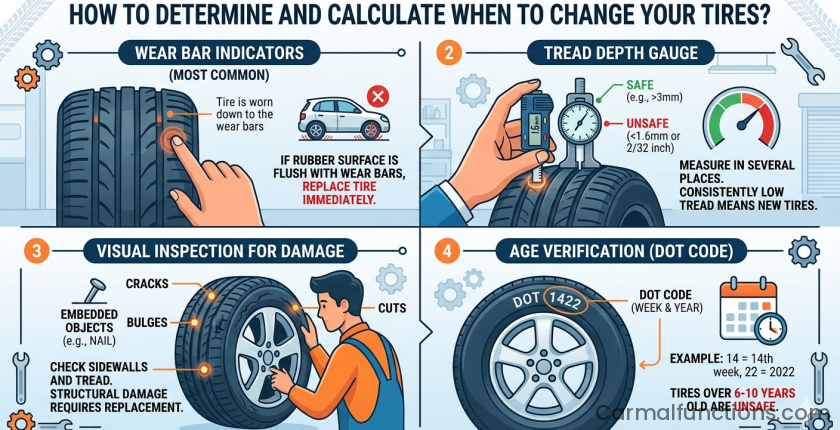
Tires are arguably the most crucial safety component of your vehicle. They are the only part in direct contact with the road, influencing everything from handling and braking distance to fuel efficiency. Knowing precisely how to determine and calculate when to change your tires is not just about preventing a breakdown; it’s a fundamental aspect of responsible vehicle ownership and road safety. Ignoring worn-out tires can lead to dangerous hydroplaning, blowouts, and costly fines. This detailed guide will walk you through the essential metrics, visual inspections, and calculations necessary to ensure your tires are always operating at peak performance.
Understanding Tire Lifespan and Factors Influencing Wear
While manufacturers provide estimates, the actual lifespan of your tires is highly variable. A general guideline suggests tires last between 50,000 and 60,000 miles, but this can drastically change based on several key factors. Understanding these variables is the first step in accurately determining when to change your tires.
Key Factors Affecting Tire Wear Rate
- Driving Habits: Aggressive acceleration, hard braking, and frequent cornering accelerate tread wear significantly.
- Road Conditions: Driving frequently on rough, unpaved, or debris-strewn roads causes faster abrasion than smooth highway driving.
- Climate and Temperature: Extreme heat can cause rubber to degrade faster, while consistently low temperatures can affect tire flexibility and increase the risk of cracking.
- Vehicle Maintenance: Improper inflation and poor wheel alignment are major contributors to uneven and premature tire wear.
- Load: Consistently carrying loads near or above the vehicle’s maximum capacity puts excessive strain on the tires.


The Primary Metric: Tread Depth Measurement
The most objective way to determine when to change your tires revolves around measuring the remaining tread depth. Tread is vital for channeling water away from the tire contact patch, providing grip, especially in wet conditions. As the tread wears down, this ability diminishes, increasing stopping distances.
Legal Requirements for Minimum Tread Depth
Most jurisdictions worldwide mandate a minimum tread depth for legal operation. Failing to meet this standard is not only unsafe but also illegal.
| Region/Standard | Minimum Tread Depth (Legal Limit) |
|---|---|
| United States (Minimum) | 2/32 of an inch (1.6 mm) |
| Canada (Minimum) | 3/32 of an inch (2.4 mm) for winter tires |
| European Union (Minimum) | 1.6 mm |
Methods for Measuring Tread Depth
To accurately assess your situation regarding how to determine and calculate when to change your tires, you need reliable measurement tools. While professional gauges offer the highest accuracy, simpler methods exist for quick checks.
Using a Tread Depth Gauge
A dedicated depth gauge is the most precise tool. Insert the probe into the deepest groove of the tire tread, ensuring the depth bar rests flat on the tread surface, and read the measurement directly. Repeat this across various points on the tire.
The Penny Test (US Standard)
A readily available alternative is the US penny. Insert Abraham Lincoln’s head upside down into the tire groove. If you can see the very top of his head, your tread is likely below 2/32 of an inch, and immediate replacement is necessary.
The Quarter Test (Recommended Safety Margin)
For added safety, especially if you frequently drive in rain or snow, use a quarter. Insert George Washington’s head upside down. If the tread does not touch the top of his head, you still have more than 4/32 of an inch of tread, which is often recommended as the replacement threshold for adverse weather.
Calculating Tire Replacement Based on Age
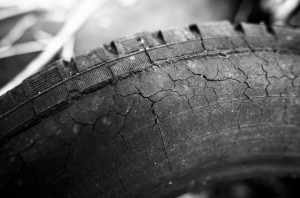
Even if the tread depth appears adequate, the rubber compound in tires naturally deteriorates over time due to oxidation and exposure to the elements. This process is known as dry rot or aging, and it compromises structural integrity.
The Five-Year Checkpoint
Most tire manufacturers and safety experts recommend having your tires inspected by a professional technician at least once every five years, regardless of mileage. This inspection checks for internal deterioration not visible externally.
The Ten-Year Rule
If your tires are older than ten years from the date of manufacture, they should be replaced, even if the tread depth seems fine. The rubber polymers have hardened significantly, increasing the risk of sudden failure.
Finding the DOT Date Code
To calculate the age of your tires, you must locate the Department of Transportation (DOT) code on the sidewall. The last four digits of this code indicate the week and year the tire was manufactured. For example, a code ending in “3521” means the tire was made in the 35th week of 2021.
Assessing Uneven Wear Patterns
One of the most critical aspects of how to determine and calculate when to change your tires involves looking beyond uniform wear. Uneven wear patterns often signal underlying mechanical issues that need correction before new tires are installed, otherwise, the new set will wear out just as quickly.
Common Wear Patterns and Their Causes
- Center Wear: Tread wears fastest in the center. Cause: Consistent overinflation.
- Edge Wear (Shoulder Wear): Tread wears faster on both inner and outer edges. Cause: Consistent underinflation.
- One-Sided Wear (Diagonal Wear): Wear concentrated only on the inner or outer edge. Cause: Incorrect wheel alignment (camber or toe issues).
- Cupping or Scalloping: Irregular, patchy wear around the circumference. Cause: Worn shock absorbers or struts, allowing the tire to bounce slightly.
If significant uneven wear is present, the necessary calculation involves addressing the mechanical fault (alignment, balancing, suspension) before calculating the remaining life of the tire based on the shallowest point.
Calculating Remaining Mileage Potential
For the most proactive drivers, calculating the remaining useful life can help budget for replacements. This calculation requires knowing the original tread depth and the current measured depth.
The Simple Estimation Formula
While not perfectly precise due to variable wear rates, this formula offers a rough estimate of remaining mileage:
Remaining Mileage = (Current Usable Tread Depth / Total Original Tread Depth) x Estimated Total Tire Life (in miles)
Example Scenario:
Assume:
- Original Tread Depth: 10/32 of an inch
- Current Measured Depth: 5/32 of an inch
- Estimated Total Tire Life: 50,000 miles
Calculation:
(5/32) / (10/32) = 0.5 (or 50% remaining)
0.5 x 50,000 miles = 25,000 miles remaining.
However, since safety dictates replacement at 2/32 of an inch, a more practical calculation focuses on the usable safety margin:
Usable Tread Depth = Current Depth – Legal Minimum (2/32)
If your current depth is 5/32, your usable safety buffer is 3/32 (5 minus 2).
If you know your wear rate (e.g., 1/32 of an inch every 10,000 miles), you can calculate:
Remaining Safe Miles = Usable Tread Depth (in 32nds) x Miles per 1/32 Wear
3/32 x 10,000 miles = 30,000 safe miles remaining.
The Importance of Tire Rotation
To maximize the accuracy of your wear calculations and extend the life of your set, regular tire rotation is non-negotiable. Rotation ensures that all four tires experience similar wear patterns by moving them through different positions on the vehicle (e.g., front to back, side to side).
Recommended Rotation Schedule
Most manufacturers recommend rotating tires every 5,000 to 8,000 miles, often coinciding with oil changes. This consistent practice helps normalize wear, making the overall calculation of when to change the set more reliable.
Beyond Tread: Visual Signs of Tire Failure
While measurements are key to how to determine and calculate when to change your tires, visual inspection can reveal immediate dangers that supersede depth calculations.
Warning Signs Requiring Immediate Action
- Visible cords or white nylon fabric showing through the rubber.
- Bulges, blisters, or cuts on the sidewall, indicating internal structural damage.
- Excessive vibration or pulling while driving, suggesting a belt separation or severe imbalance.
- Cracking or deep weathering in the grooves or on the sidewall that extends beyond minor surface aging.
When these signs appear, the calculation shifts from “when will they be worn out” to “how quickly can I get them replaced.”
By systematically checking tread depth against legal and safety margins, monitoring the age of the rubber using the DOT code, and diligently observing wear patterns indicative of mechanical issues, any driver can accurately determine and calculate precisely when their tires have reached the end of their safe service life, ensuring optimal safety and performance on the road.


