225 70R 15CP Tire Air Pressure
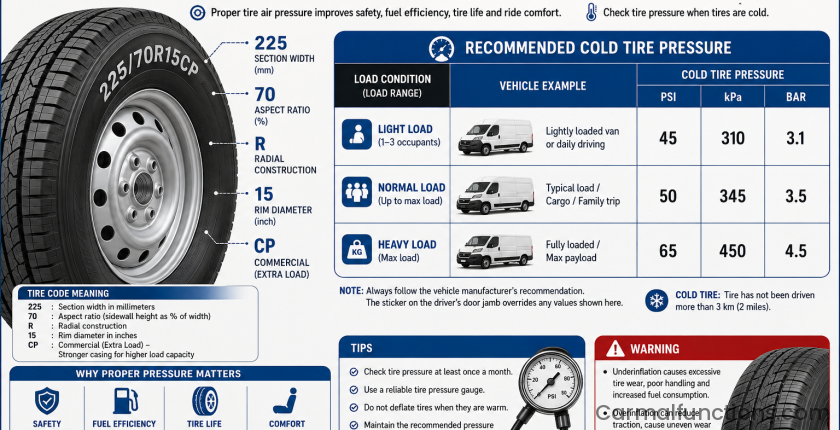
Comprehensive Guide: 225 70R 15CP Tire Air Pressure For motorhomes, the recommended ideal pressure values are typically between 44-48 PSI (3.0-3.3 Bar) for front tires and 42-46 PSI (2.9-3.2 Bar) for rear tires under normal loads. Under full load, these values increase to 50-54 PSI (3.4-3.7 Bar) for the front...

- 1. Comprehensive Guide: 225 70R 15CP Tire Air Pressure
- 1.1. Why is 225/70R 15CP Tire Pressure So Important?
- 1.2. What is a “CP” Tire?
- 1.3. 225/70R 15CP Tire Pressure Table
- 1.4. Seasonal Management and Maintenance
- 1.5. Risks of Incorrect Pressure
- 1.5.1. Low Pressure Risks:
- 1.5.2. High Pressure Risks:
- 1.6. Motorhome Tire Care Tips
- 1.7. Frequently Asked Questions (FAQ)
Comprehensive Guide: 225 70R 15CP Tire Air Pressure
For motorhomes, the recommended ideal pressure values are typically between 44-48 PSI (3.0-3.3 Bar) for front tires and 42-46 PSI (2.9-3.2 Bar) for rear tires under normal loads. Under full load, these values increase to 50-54 PSI (3.4-3.7 Bar) for the front and 48-52 PSI (3.3-3.6 Bar) for the rear.
Why is 225/70R 15CP Tire Pressure So Important?
Motorhomes are unique vehicles. They carry substantial weight and have a high center of gravity, putting immense pressure on the tires. Correct pressure is the key to managing this stress.
-
Safe Driving and Handling: Proper pressure ensures an ideal contact patch with the road. This shortens braking distances and provides stability during sudden maneuvers.
-
Fuel Efficiency: Low pressure increases rolling resistance, forcing the engine to use more energy and increasing fuel consumption.
-
Tire Life: Correct pressure ensures even wear. Under-inflation causes excessive wear on the edges and risks overheating, while over-inflation accelerates wear in the center of the tread.
What is a “CP” Tire?
The “CP” marking stands for “Camping Pneu” or “Camper Tyre.” These are specifically engineered for motorhomes.
-
Reinforced Structure: They have a strengthened carcass and sidewalls to handle the static load of a parked motorhome.
-
Higher Pressure Tolerance: They are designed to operate at higher pressures than standard commercial (C) tires.
-
Better Stability: They provide increased stability for tall, heavy vehicles, as recommended by ETRTO standards.
225/70R 15CP Tire Pressure Table
| Condition | Recommended Pressure (PSI) | Recommended Pressure (Bar) |
| Normal Load (Front) | 44-48 PSI | 3.0-3.3 Bar |
| Normal Load (Rear) | 42-46 PSI | 2.9-3.2 Bar |
| Full Load (Front) | 50-54 PSI | 3.4-3.7 Bar |
| Full Load (Rear) | 48-52 PSI | 3.3-3.6 Bar |
Note: These are general guidelines. Always prioritize the values found in your vehicle’s manual or on the door pillar sticker.
Seasonal Management and Maintenance
-
Summer: Air expands in heat. Check pressures early in the morning when the tires are cold.
-
Winter: Cold air causes pressure to drop. Check frequently during winter; increasing the pressure by 1-2 PSI may be beneficial to compensate for the cold.
-
Check Routine: Check your tires at least once a month and before every long journey. Always measure when cold (at least three hours after driving).
Risks of Incorrect Pressure
Low Pressure Risks:
-
Overheating: The sidewalls flex too much, leading to internal heat build-up and potential blowouts.
-
Reduced Control: Steering becomes sluggish and braking distances increase.
-
Increased Costs: Higher fuel consumption and faster tire degradation.
High Pressure Risks:
-
Reduced Traction: The contact patch shrinks, leading to less grip, especially on wet roads.
-
Harsher Ride: The tires become very stiff, meaning you feel every bump in the road, which adds stress to the suspension.
-
Impact Damage: Harder tires are more susceptible to damage from potholes or road debris.
Motorhome Tire Care Tips
-
Tread Depth: Ensure it does not fall below the legal limit (usually 1.6 mm).
-
Sidewall Inspection: Look for cracks, bulges, or “bubbles.” These indicate internal structural damage.
-
Rotation: Rotate your tires approximately every 10,000 km to ensure even wear.
-
Storage: If the motorhome is parked for long periods, protect the tires from direct sunlight (UV rays) to prevent “dry rot” or cracking.
Frequently Asked Questions (FAQ)
Where can I find the specific pressure for my motorhome?
Check the owner’s manual, the driver’s door jamb, or the inside of the fuel filler flap. Do not use the “Max PSI” on the tire sidewall as your daily driving pressure.
Does low pressure really affect my fuel?
Yes. Under-inflated tires create more friction against the road, which can significantly lower your miles-per-gallon (MPG).
How often should I check the pressure?
At least once a month and before every trip. Tires naturally lose air over time, even without a puncture.
Can I check it myself?
Absolutely. All you need is a simple pressure gauge. Just ensure you do it while the tires are cold for an accurate reading.