What is the difference between diesel and gasoline? Fuel, maintenance, and costs.
The automotive world presents consumers with a fundamental choice when purchasing a new vehicle: gasoline or diesel. While both fuels power internal combustion engines, their underlying chemistry, performance characteristics, long-term ownership costs, and environmental impacts differ significantly. Understanding what is the difference between diesel and gasoline? Fuel, maintenance, and costs...

The automotive world presents consumers with a fundamental choice when purchasing a new vehicle: gasoline or diesel. While both fuels power internal combustion engines, their underlying chemistry, performance characteristics, long-term ownership costs, and environmental impacts differ significantly. Understanding what is the difference between diesel and gasoline? Fuel, maintenance, and costs is crucial for making an informed decision that aligns with your driving habits and priorities.
- 1. The Fundamental Chemical and Combustion Distinction
- 1.1. Gasoline (Petrol) Composition and Ignition
- 1.2. Diesel Fuel Composition and Ignition
- 2. Engine Design Implications
- 2.1. Spark Ignition (Gasoline) Engine Characteristics
- 2.2. Compression Ignition (Diesel) Engine Characteristics
- 3. Performance, Efficiency, and Fuel Economy
- 3.1. Fuel Economy Advantage of Diesel
- 3.2. Torque vs. Horsepower
- 4. Maintenance and Longevity Considerations
- 4.1. Gasoline Engine Maintenance
- 4.2. Diesel Engine Maintenance
- 5. The Cost Equation: Purchase Price and Fueling
- 5.1. Initial Purchase Price
- 5.2. Fuel Price Volatility
- 5.3. Resale Value
- 6. Environmental and Noise Factors
- 6.1. Emissions Comparison
- 6.2. Noise and Vibration (NVH)
The Fundamental Chemical and Combustion Distinction
At the heart of the difference lies the fuel itself and how the engine utilizes it to generate power. Diesel and gasoline are refined from crude oil but undergo distinct processes, resulting in fuels with varied energy densities and ignition points.
Gasoline (Petrol) Composition and Ignition
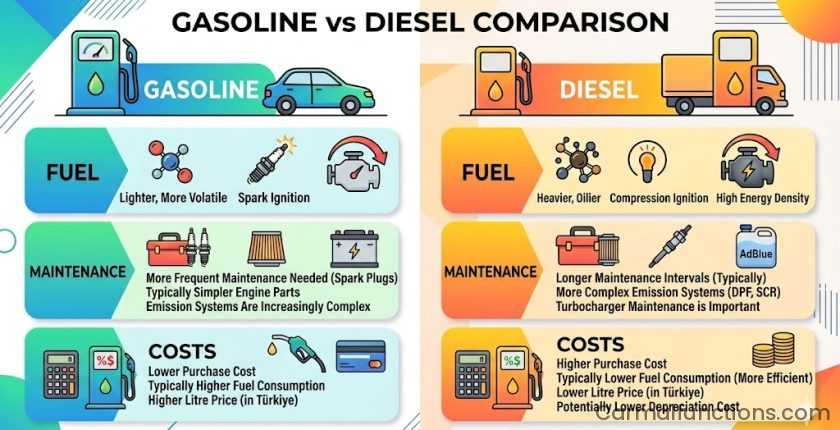
Gasoline is a lighter, more volatile fuel. Its refining process focuses on creating a fuel that vaporizes easily, allowing it to mix thoroughly with air before ignition. The defining characteristic of gasoline engines (Spark Ignition engines) is the use of a spark plug to initiate combustion.
- Octane Rating: Gasoline is rated by its octane number, which measures its resistance to premature detonation or “knocking” under compression. Higher octane fuels allow for higher compression ratios, increasing efficiency.
- Volatility: It evaporates readily, which is necessary for effective mixing with air in the intake manifold or direct injection systems.
- Engine Type: Typically found in smaller, lighter passenger vehicles, though high-performance engines use it extensively.
Diesel Fuel Composition and Ignition
Diesel fuel is denser, oilier, and less volatile than gasoline. It has a higher energy content per gallon, meaning it contains more potential energy to convert into mechanical work. Diesel engines (Compression Ignition engines) rely on heat generated by extreme compression to ignite the fuel.
- Cetane Rating: Diesel is rated by its cetane number, which measures how quickly and completely the fuel ignites under compression. Higher cetane means a shorter ignition delay.
- Energy Density: Diesel fuel provides approximately 10-15% more energy per unit volume than gasoline.
- Engine Type: Predominantly used in heavy-duty trucks, commercial vehicles, agricultural equipment, and increasingly, in modern passenger SUVs and light trucks where torque is prioritized.
Engine Design Implications
The method of ignition dictates the entire architecture of the engine. This structural difference profoundly impacts performance, noise, and durability.
Spark Ignition (Gasoline) Engine Characteristics
Gasoline engines operate at lower compression ratios (typically 8:1 to 12:1). This lower pressure requirement means the engine components do not need to be as robustly built as their diesel counterparts.
Compression Ignition (Diesel) Engine Characteristics
Diesel engines require much higher compression ratios (often 14:1 up to 22:1) to generate the necessary heat for auto-ignition. This necessitates heavier engine blocks, stronger pistons, and more durable connecting rods.
| Feature | Gasoline Engine | Diesel Engine |
|---|---|---|
| Ignition Method | Spark Plug | High Compression Heat |
| Typical Compression Ratio | Lower (8:1 – 12:1) | Higher (14:1 – 22:1) |
| Fuel Delivery | Throttle Body or Port/Direct Injection | High-Pressure Direct Injection |
| Power Focus | Horsepower (High RPM) | Torque (Low RPM) |
Performance, Efficiency, and Fuel Economy
When exploring what is the difference between diesel and gasoline? Fuel, maintenance, and costs, efficiency is often the primary concern for long-distance drivers.
Fuel Economy Advantage of Diesel
Due to diesel’s higher energy density and the inherent thermodynamic efficiency of the compression-ignition cycle, diesel engines almost always deliver better miles per gallon (MPG) compared to similarly sized gasoline engines. This efficiency gain is usually substantial, often ranging from 20% to 40% better fuel economy.
Torque vs. Horsepower
Diesel engines excel at producing high levels of torque at low engine speeds (RPM). Torque is the rotational force that gets heavy loads moving, making diesel the preferred choice for towing, hauling, and climbing steep grades. Gasoline engines, conversely, generally produce higher peak horsepower at higher RPMs, leading to better acceleration in lighter vehicles.
Maintenance and Longevity Considerations
Maintenance profiles diverge significantly between the two fuel types, particularly concerning the lifespan and repair costs of major components.
Gasoline Engine Maintenance
Gasoline engines typically require more frequent maintenance items related to the ignition system and air/fuel mixture control.
- Spark Plugs: Must be replaced periodically (e.g., every 30,000 to 100,000 miles, depending on the type).
- Oil Changes: Generally recommended more frequently than diesel engines due to higher operating temperatures and potentially more combustion byproducts entering the oil.
- Complexity: Modern gasoline engines with turbochargers and direct injection are becoming increasingly complex, but the base maintenance schedule is often perceived as simpler.
Diesel Engine Maintenance
Diesel engines are built tougher to withstand higher internal pressures, often resulting in longer overall engine life, especially in heavy-duty applications. However, modern diesel emissions control systems introduce significant complexity and potential cost.
The primary maintenance challenge in modern diesels revolves around emissions controls:
- Diesel Particulate Filters (DPF): These trap soot but require periodic regeneration (burning off the soot), which can be problematic if the vehicle is only driven short distances. Replacement costs are high.
- Selective Catalytic Reduction (SCR) / Diesel Exhaust Fluid (DEF): This system requires the regular replenishment of DEF, an ammonia-based solution necessary to reduce Nitrogen Oxide (NOx) emissions.
- Fuel System: Injectors and high-pressure fuel pumps are precision components that can be expensive to repair or replace if contaminated fuel is used.
The Cost Equation: Purchase Price and Fueling
Examining what is the difference between diesel and gasoline? Fuel, maintenance, and costs requires looking at the total cost of ownership (TCO).
Initial Purchase Price
Vehicles equipped with diesel engines often carry a higher initial sticker price than their gasoline counterparts. This premium reflects the more robust construction, the cost of high-pressure fuel injection systems, and the added expense of complex emissions control hardware.
Fuel Price Volatility
Historically, diesel fuel prices fluctuate independently of gasoline prices. While diesel fuel sometimes costs less per gallon than regular gasoline, it often trades at a premium in many markets, especially when trucking demand is high. The saving in fuel economy must outweigh the higher price per gallon to realize significant savings.
Resale Value
In certain segments (like heavy-duty trucks and large SUVs), diesel models often retain a higher resale value due to the perceived longevity and towing capability associated with the engine type.
Environmental and Noise Factors
Environmental regulations have profoundly shaped the modern diesel engine, creating a complex trade-off between efficiency and emissions output.
Emissions Comparison
Historically, diesel engines were notorious for producing high levels of particulate matter (soot) and NOx. Modern diesel engines, thanks to DPFs and SCR systems, have dramatically reduced soot output, often making them cleaner than older gasoline engines regarding particulate matter.
However, gasoline engines generally produce lower levels of NOx naturally, and while modern gasoline direct injection (GDI) engines also require complex catalytic converters, they avoid the need for DEF.
Noise and Vibration (NVH)
Due to the rapid, explosive nature of compression ignition, diesel engines are traditionally louder and exhibit more vibration than gasoline engines, especially at idle. While modern common-rail diesel technology has substantially quieted these engines, they still typically produce a characteristic “clatter” compared to the smoother operation of gasoline counterparts.
Ultimately, the choice between diesel and gasoline hinges on usage patterns. For drivers who prioritize maximum towing capacity, haul heavy loads regularly, or cover very high annual mileage (where the superior fuel economy can offset the higher initial cost), diesel remains a compelling option. For the average commuter or city driver prioritizing a lower initial purchase price, simpler maintenance, and quieter operation, gasoline remains the standard choice. The modern landscape means that both technologies are highly refined, yet their fundamental differences in how they convert stored energy into motion continue to define their respective roles on the road.