How to Adjust Car Tire Pressure?
The Importance of Correct Tire Pressure: Why It Matters Maintaining the manufacturer’s recommended pressure is not just about maintenance; it’s a fundamental safety requirement. Proper inflation ensures the tire has the optimum contact patch with the road. Driving Safety: Correct pressure improves handling and shortens braking distances. Under-inflated tires can...

The Importance of Correct Tire Pressure: Why It Matters
Maintaining the manufacturer’s recommended pressure is not just about maintenance; it’s a fundamental safety requirement. Proper inflation ensures the tire has the optimum contact patch with the road.
-
Driving Safety: Correct pressure improves handling and shortens braking distances. Under-inflated tires can overheat and risk a blowout, while over-inflated tires reduce grip, causing the vehicle to slide during maneuvers.
-
Fuel Efficiency: Properly inflated tires reduce rolling resistance. Low pressure forces the engine to work harder, increasing fuel consumption and costs.
-
Tire Longevity: Correct pressure ensures even wear. Low pressure wears out the “shoulders” (edges) of the tire, while high pressure wears out the center.

When to Check Your Tire Pressure
Tires naturally lose about 0.069 bar (1 PSI) per month. This rate increases with temperature fluctuations.
-
The Cold Tire Rule: Always measure pressure when tires are “cold”—meaning the car has been parked for at least three hours or driven less than 1.6 km.
-
Frequency: Check at least once a month and always before long trips.
-
Seasonal Changes: For every 10°C drop in temperature, tire pressure drops. Check more frequently during autumn and winter.
Tools and Location of Values
To adjust your pressure, you need a Manometer (Pressure Gauge), an Air Compressor, and your Valve Caps.
Where to find your car’s PSI/Bar values:
| Location | Description |
| Driver’s Door Pillar | A sticker showing values for front/rear tires and load conditions. |
| Fuel Flap | Inside the fuel filler door. |
| Owner’s Manual | The most detailed source for your specific model. |
Note: Do not use the “Max Pressure” listed on the tire sidewall; this is the tire’s limit, not the car’s recommended setting. Most passenger cars require 30-35 PSI (2.1-2.4 BAR).
Step-by-Step: How to Adjust Tire Pressure
-
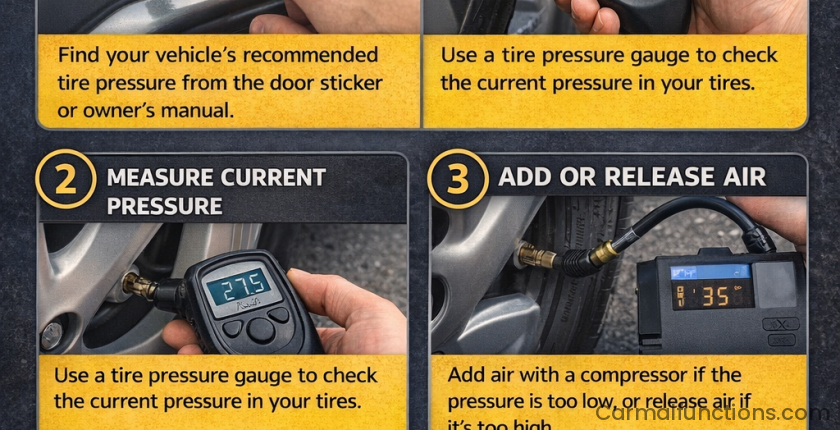
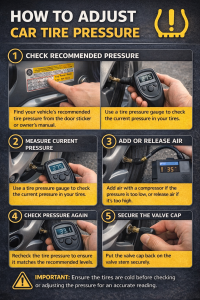
Ensure tires are cold.
-
Remove the valve cap and keep it in a safe place.
-
Check current pressure: Press the gauge firmly onto the valve. Note the reading.
-
Adjust:
-
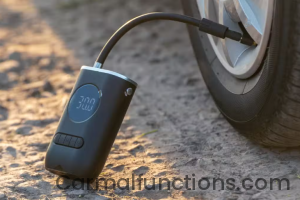
If low: Add air in small bursts using a compressor.
-
If high: Press the small pin inside the valve to release air.
-
-
Final Check: Re-measure to ensure accuracy.
-
Replace the valve cap tightly to prevent leaks and dirt entry.
Seasonal Adjustments & TPMS
-
Winter: Cold air contracts. You may need to add air more often to maintain the recommended levels.
-
Summer: Heat causes air to expand. Ensure you still set the pressure while the tire is cold to avoid false high readings.
-
TPMS (Tire Pressure Monitoring System): This electronic system alerts you via a dashboard light (usually shaped like a horseshoe with an exclamation mark) if pressure drops significantly. Remember to reset the TPMS via your car’s menu after adjusting pressures or changing tires.
Frequently Asked Questions (FAQ)
How often should I check?
At least once a month and before every long journey.
What happens if the pressure is too high?
The ride becomes bumpy, the center of the tire wears out faster, and traction is reduced, increasing braking distances.
What happens if the pressure is too low?
Fuel consumption increases, steering becomes “heavy,” the edges of the tires wear out, and there is a high risk of overheating or blowouts.
Is PSI or Bar better?
Both are valid units of measurement. Most gauges show both. Just ensure you match the unit shown on your vehicle’s information sticker.
Are gas station pumps accurate?
They are generally fine for convenience, but they can be uncalibrated. Using your own high-quality digital gauge is the most reliable method.