Abarth 124 Spider Tire Air Pressure
Why Correct Abarth 124 Spider Tire Pressure is Vital Maintaining the correct tire pressure for your Abarth 124 Spider directly enhances your driving experience across multiple fronts. Incorrect tire pressure can cause overheating, uneven tread wear, and an increased risk of dangerous blowouts—compromising your safety while significantly shortening tire lifespan....

- 1. Why Correct Abarth 124 Spider Tire Pressure is Vital
- 1.1. Impact on Driving Dynamics
- 1.2. Fuel Efficiency and Tire Pressure
- 1.3. Tire Lifespan and Air Pressure
- 2. Correct Tire Pressure Values for the Abarth 124 Spider
- 2.1. Front and Rear Tire Pressures
- 2.2. Tire Pressure Table (Reference Values)
- 3. How to Check Abarth 124 Spider Tire Pressure
- 3.1. Required Equipment
- 3.2. Step-by-Step Inspection Guide
- 3.3. Inspection Frequency
- 4. Frequently Asked Questions (FAQ)
- 5. Advanced Tire Pressure Optimization
- 5.1. Performance and Track Adjustments
- 5.2. Load-Dependent Calibration
- 5.3. Comprehensive Wheel and Tire Maintenance
Why Correct Abarth 124 Spider Tire Pressure is Vital
Maintaining the correct tire pressure for your Abarth 124 Spider directly enhances your driving experience across multiple fronts. Incorrect tire pressure can cause overheating, uneven tread wear, and an increased risk of dangerous blowouts—compromising your safety while significantly shortening tire lifespan.
Furthermore, fuel consumption is directly impacted by inflation levels. Under-inflating your tires increases rolling resistance, forcing the engine to work harder and consume more fuel. Conversely, over-inflated tires decrease road grip, deliver a harsh and stiff ride, and place unnecessary strain on your vehicle’s suspension system. Adhering to the manufacturer’s recommended tire pressure values is essential for safeguarding your vehicle’s performance.
Impact on Driving Dynamics
Tire pressure determines the exact contact patch between your vehicle and the road. This surface area maintains vehicle stability during dynamic maneuvers such as cornering, braking, and accelerating. Optimal pressure ensures a balanced footprint, translating directly to maximum road grip and sharp handling.
-
Under-inflation: Causes the tire sidewalls to flex excessively, resulting in sluggish steering responses, compromised handling in tight corners, accelerated wear, and dangerous thermal buildup.
-
Over-inflation: Distorts the tire profile and shrinks the contact patch. This layout extends braking distances and drastically reduces wet-weather traction while stiffening the ride.
Fuel Efficiency and Tire Pressure
The relationship between fuel economy and tire pressure is highly significant. Under-inflated tires suffer from higher rolling resistance, demanding more power from the engine to move forward. Organizations like the National Highway Traffic Safety Administration (NHTSA) state that maintaining correct tire pressure can improve fuel economy by up to 3%. Over time, this routine practice results in noticeable financial savings and a reduced environmental footprint.
Tire Lifespan and Air Pressure
Incorrect inflation patterns cause highly uneven tread wear, forcing premature and costly tire replacements.
-
Low pressure forces the vehicle’s weight onto the outer edges, wearing down the shoulders of the tire while leaving the center intact.
-
High pressure balloons the tire outward, causing the center of the tread to wear down rapidly.
By maintaining exact factory specifications, you maximize the service life of your performance tires.
Correct Tire Pressure Values for the Abarth 124 Spider
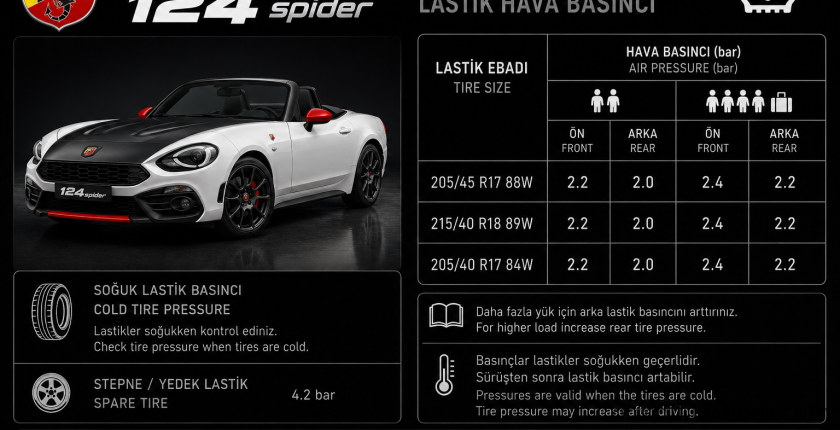
Recommended tire pressure specifications for the Abarth 124 Spider may vary slightly depending on the model year and installed tire sizes. Factory benchmarks are located on the placard inside the driver’s door jamb, the fuel filler flap, or within the owner’s manual.
Front and Rear Tire Pressures
The Abarth 124 Spider typically utilizes an identical pressure distribution across both the front and rear axles to preserve its near-perfect front-to-back weight balance. However, minor adjustments can be made depending on passenger and cargo loads. Under fully loaded conditions, slightly increasing the rear axle pressure can offset added weight. Always defer to your specific door placard or manual.
Tire Pressure Table (Reference Values)
The following table provides a general baseline guide for the Abarth 124 Spider. Always verify these numbers against your vehicle’s official documentation:
| Tire Position | Recommended Pressure (PSI) | Recommended Pressure (Bar) |
| Front Tires | 32 PSI | 2.2 Bar |
| Rear Tires | 32 PSI | 2.2 Bar |
| Spare Tire (If Equipped) | 60 PSI | 4.1 Bar |
Note: These values are general reference points. For your car’s exact specifications, look closely at the driver’s door frame sticker.
How to Check Abarth 124 Spider Tire Pressure
Checking tire pressure is a quick process that yields the most accurate data when performed using proper tools and correct timing. Measurements must be taken when the tires are cold—meaning the car has been stationary for at least three hours or driven less than 2 kilometers at low speeds.
Required Equipment
-
A high-quality digital or analog tire pressure gauge (digital gauges offer higher precision).
-
An air compressor or portable inflator pump (available at most service stations).
Step-by-Step Inspection Guide
-
Ensure Cold State: Never take baseline measurements immediately after spirited driving; hot air expansion will yield false, elevated readings.
-
Remove Valve Cap: Unscrew the protective cap from the tire valve stem and store it safely.
-
Attach Gauge: Press your pressure gauge firmly and squarely onto the valve stem. Ensure no air escapes around the nozzle.
-
Read Value: Note the current PSI or Bar reading displayed on the indicator screen.
-
Compare Against Spec: Match your recorded value against the factory numbers on your vehicle’s door placard.
-
Adjust Accordingly: If pressure reads low, engage an air compressor to add air. If it reads high, gently depress the center pin inside the valve stem to release air in small increments, checking frequently until exact.
-
Secure Valve Cap: Tighten the cap back onto the stem to block dirt, road grit, and moisture from corrupting the valve core.
Inspection Frequency
Air pressure naturally migrates outward through the tire structure over time and shifts rapidly with outdoor climate changes. Check your tires at least once a week, before setting off on long road trips, and during major seasonal changes. Because dropping temperatures cause internal air molecules to contract, cold winter weather requires more frequent monitoring.
Frequently Asked Questions (FAQ)
Where can I find the recommended tire pressure for my Abarth 124 Spider?
It is located on a placard affixed to the driver’s side door pillar or inside the fuel filler door. It is also detailed in the technical specifications section of your owner’s manual.
Should I check my tire pressure when hot or cold?
Always when cold. Checking hot tires provides artificially elevated readings due to thermal expansion, which can lead to dangerous under-inflation if you bleed air out.
What should the pressure of the spare tire be?
Space-saver spare tires require significantly higher pressure to retain their shape and structural integrity, typically around 60 PSI. Check your spare tire’s sidewall or door placard to confirm.
What happens if my tire pressure is too low?
Under-inflation compromises structural grip, increases fuel usage, accelerates shoulder wear, and elevates the risks of overheating and sidewall failure.
What happens if my tire pressure is too high?
Over-inflation reduces your contact patch, hurts braking performance, accelerates center tread wear, and creates a stiff, uncomfortable ride quality.
How does ambient air temperature affect tire pressure?
As ambient temperatures drop, the air inside your tire condenses, reducing overall pressure. Conversely, heat causes air to expand. A general rule of thumb is that every 10°C (18°F) drop in outside temperature lowers your tire pressure by approximately 1 PSI.
What should I do if I run aftermarket or alternative tire sizes?
If you deviate from original factory specifications, match your operating pressures to the guidelines provided by the tire manufacturer for that specific size, keeping the vehicle’s total curb weight in mind.
What does the Tire Pressure Monitoring System (TPMS) do?
The TPMS continuously reads internal tire pressures while driving and triggers a dashboard alert if any tire drops below its safe baseline. While highly useful for catching sudden leaks, it does not replace regular manual checks with a dedicated gauge.
Advanced Tire Pressure Optimization
Performance and Track Adjustments
For closed-circuit track days or spirited performance driving, some enthusiasts adjust cold pressures slightly higher to stiffen the tire sidewall and sharpen steering response. Reducing sidewall roll helps the car feel more immediate off-center.
However, track use generates immense internal heat, which quickly balloons operating pressures. Always monitor hot pressures immediately after track sessions to ensure they do not exceed the tire manufacturer’s safe operational thresholds.
Load-Dependent Calibration
When preparing your sports car for an extended road trip with a passenger and heavy luggage, adding 2–4 PSI to the rear tires keeps the rear suspension stable and prevents excessive tire deflection under weight. Never exceed the gross vehicle weight rating (GVWR) stamped on your door placard.
Comprehensive Wheel and Tire Maintenance
Correct tire inflation is only one component of proper wheel care. To extract peak performance out of your Abarth 124 Spider, implement these habits:
-
Monitor remaining tread depth regularly across the entire face of the tire.
-
Inspect tire sidewalls closely for cracks, gouges, or bubbles.
-
Check alloy rims for signs of impact damage or distortion.
-
Perform a tire rotation every 8,000 to 10,000 kilometers to encourage uniform wear across both axles.