Abarth Grande Punto Tire Pressure
Abarth Grande Punto Tire Pressure Guide: Performance, Safety, and Efficiency Maintaining the correct tire pressure on your Abarth Grande Punto is absolutely critical for your car’s overall performance, driving safety, and fuel efficiency. Proper inflation ensures optimum road holding, shorter braking distances, and a significantly longer lifespan for your tires....

- 1. Abarth Grande Punto Tire Pressure Guide: Performance, Safety, and Efficiency
- 1.1. Why is Tire Pressure Critical for Your Abarth Grande Punto?
- 1.2. How to Find the Right Tire Pressure for Your Vehicle
- 1.2.1. 1. The Vehicle Information Plaquard
- 1.2.2. 2. The Owner’s Manual
- 1.2.3. 3. General Guidelines (Use with Caution)
- 1.3. Abarth Grande Punto Tire Pressure Tables
- 1.3.1. Standard Abarth Grande Punto Reference Values
- 1.3.2. Abarth 500/595 Tire Pressure (For Comparison Only)
- 1.4. Special Driving Scenarios and Adjustments
- 1.4.1. High-Speed Autobahn Driving
- 1.4.2. Winter Tires
- 1.4.3. Driving on Sand
- 1.4.4. Urban Fuel Saving
- 1.5. Tire Pressure Monitoring and Maintenance
- 1.5.1. When Should You Check It?
- 1.5.2. Always Measure Cold
- 1.5.3. Rely on Quality Gauges
- 1.5.4. Understanding Your TPMS
- 1.6. Frequently Asked Questions (FAQ)
- 1.6.1. Where can I find the recommended tire pressure for my Abarth Grande Punto?
- 1.6.2. Why do tire pressure units differ across gauges?
- 1.6.3. How often should I check my tire pressure?
- 1.6.4. Should I check pressure when the tires are hot or cold?
- 1.6.5. What happens if I drive with incorrect tire pressure?
- 1.6.6. Is the maximum pressure listed on the tire sidewall the recommended setting?
- 1.6.7. I am running aftermarket wheel sizes; how should I adjust my pressure?
- 1.6.8. My TPMS light is on, but my tire pressures are perfectly correct. What should I do?
- 1.7. Summary
Abarth Grande Punto Tire Pressure Guide: Performance, Safety, and Efficiency
Maintaining the correct tire pressure on your Abarth Grande Punto is absolutely critical for your car’s overall performance, driving safety, and fuel efficiency. Proper inflation ensures optimum road holding, shorter braking distances, and a significantly longer lifespan for your tires.
In this comprehensive guide, you will discover all the essential information, reference tables, and maintenance tips to help you find the ideal tire pressure for your hot hatch.
Why is Tire Pressure Critical for Your Abarth Grande Punto?
Tire pressure fundamentally dictates how a vehicle interacts with the road. Keeping your Abarth Grande Punto’s tires inflated to the exact manufacturer specifications serves several vital purposes:
-
Safety: Properly inflated tires maximize the vehicle’s grip on the tarmac. Consequently, this enhances steering control, especially when tackling sharp corners or navigating wet roads. Correct pressure also shortens your braking distance and prevents the tires from overheating, which drastically reduces the risk of a high-speed blowout. Conversely, incorrect pressure compromises the car’s balance and can lead to a sudden loss of control.
-
Fuel Efficiency: When tire pressure drops below the recommended level, rolling resistance increases. This forces the engine to work much harder to move the car forward, which directly spikes your fuel consumption. Maintaining the correct tire pressure can improve fuel economy by up to 3%. Over time, these small savings add up to a significant financial advantage.
-
Tire Longevity: Both over-inflation and under-inflation cause highly uneven tread wear. Under-inflated tires typically wear out faster along their outer edges, whereas over-inflated tires suffer accelerated wear right down the center. Keeping the pressure balanced ensures even tread wear, extends the life of your tires, and saves you money on premature replacements.
-
Ride Comfort: Correctly pressurized tires absorb road imperfections much better, providing a smoother driving experience. If you over-inflate the tires, they will transmit every bump directly into the cabin, resulting in a harsh, stiff ride. On the other hand, under-inflation makes the car feel sluggish and boat-like.
How to Find the Right Tire Pressure for Your Vehicle
You can easily locate the exact tire pressure specifications for your Abarth Grande Punto through a few reliable channels:
1. The Vehicle Information Plaquard
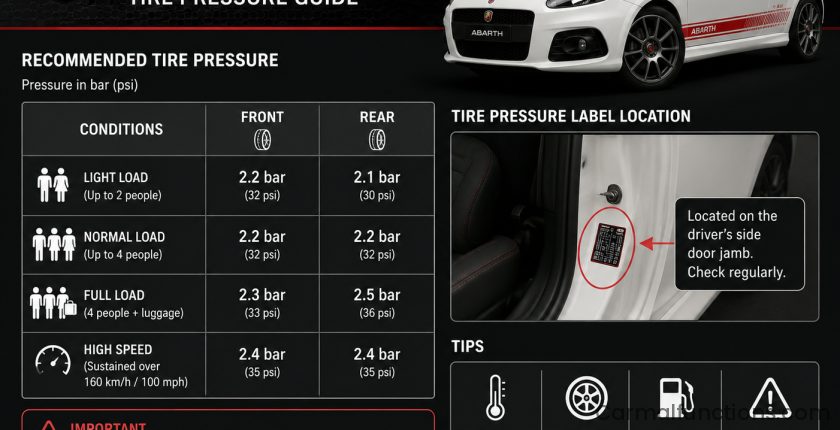
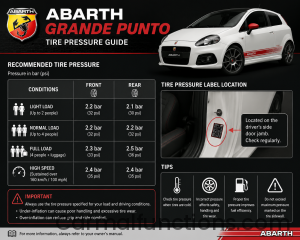
The most accurate data comes directly from the manufacturer sticker affixed to your vehicle. You can typically find this label on the driver’s door pillar, inside the fuel filler flap, or inside the glove box. This placard displays the recommended front and rear tire pressures for your original tire sizes, categorized by different load conditions (lightly loaded vs. fully laden). Checking this sticker is always your most reliable method.
2. The Owner’s Manual
Your car’s official owner’s manual serves as the primary source for all technical data. Within its pages, you will find comprehensive charts detailing the exact tire pressure values tailored specifically to your exact model variant.
3. General Guidelines (Use with Caution)
While generic charts exist online, they often fail to address the specific performance requirements of your sporty Abarth. For instance, while a standard passenger car might only require 34 psi, a high-performance vehicle like the Abarth Grande Punto might require up to 40 psi under certain conditions. Therefore, you should always prioritize your car’s specific placard or manual over generic internet advice.
Abarth Grande Punto Tire Pressure Tables
Recommended tire pressures vary based on your specific model year, engine variant, and wheel size. The tables below provide excellent general reference points. However, please double-check your vehicle’s physical door sticker to verify your exact setup.
Standard Abarth Grande Punto Reference Values
The following figures represent common tire dimensions and load conditions utilized by this model:
| Tire Size | Load Condition | Front Pressure (PSI) | Rear Pressure (PSI) |
| 215/45 R17 | Lightly Loaded | 35 | 30 |
| 215/45 R17 | Fully Laden | 33 | 32 |
| 215/40 R18 | Lightly Loaded | 35 | 32 |
| 215/40 R18 | Fully Laden | — | — |
| 195/55 R16 | Lightly Loaded | 32 | 30 |
| 195/55 R16 | Fully Laden | 32 | 30 |
| 185/65 R15 | Lightly Loaded | 32 | 29 |
| 185/65 R15 | Fully Laden | 32 | 29 |
Note: This table compiles general data from various automotive technical databases. Always cross-reference these numbers with your car’s specific door placard.
Abarth 500/595 Tire Pressure (For Comparison Only)
For drivers interested in how the Grande Punto compares to its smaller sibling, here are the baseline numbers for the Abarth 500/595 models:
| Tire Size | Load Condition | Front Pressure (PSI) | Rear Pressure (PSI) |
| 195/45 R16 | Unladen | 33 | 38 |
| 195/45 R16 | Laden | 30 | 35 |
| 205/40 R17 | Unladen | 33 | 38 |
| 205/40 R17 | Laden | 30 | 35 |
Note: These specific values belong exclusively to the Abarth 500/595 lineup and should not be used on a Grande Punto.
Special Driving Scenarios and Adjustments
Certain driving environments require temporary adjustments to your standard tire pressures. Always consult your manual before making drastic changes.
High-Speed Autobahn Driving
If you plan to travel at sustained speeds exceeding 160 km/h (100 mph), manufacturers generally recommend increasing your tire pressure to the “Fully Laden” values. This simple adjustment stabilizes the tire sidewalls and enhances safety at high velocities.
Winter Tires
When swapping to winter tires, experts frequently advise adding an extra 0.2 bar (approximately 3 psi) above the standard recommendation. This slight increase helps the winter tread compounds flex correctly, providing better biting grip on snow and ice.
Driving on Sand
If you ever need to cross deep sand, lowering your tire pressure down to around 15 psi can save you from getting stuck. Dropping the pressure widens the tire’s footprint, creating a larger contact patch that floats over soft terrain. However, you must reinflate the tires immediately upon returning to hard pavement to avoid severe rim or tire damage.
Urban Fuel Saving
Some city drivers increase their tire pressure by 3 to 4 psi to minimize rolling resistance and boost fuel economy. While this trick works, it comes with a trade-off. It noticeably reduces ride comfort, compromises maximum cornering grip, and accelerates wear down the center of the tread.
Tire Pressure Monitoring and Maintenance
Checking your tire pressure regularly represents one of the easiest ways to keep your vehicle performing at its absolute best. Keep these fundamental rules in mind:
When Should You Check It?
You should inspect your tire pressures at least once every two weeks and always before embarking on a long road trip. Furthermore, remember that seasonal temperature drops naturally lower your tire pressure; a sudden cold snap will instantly deflate your tires by a few psi.
Always Measure Cold
Always measure pressure when the tires are completely cold. Driving even a short distance generates friction heat, which causes the air inside the tire to expand and show a falsely elevated reading.
Rely on Quality Gauges
Invest in a reliable digital tire pressure gauge. Do not rely solely on your dashboard’s TPMS (Tire Pressure Monitoring System) warning light. The dashboard light is designed as an emergency indicator, meaning it only illuminates after your pressure has already dropped to a dangerously low level.
Understanding Your TPMS
Many Abarth Grande Punto models feature a built-in TPMS. If the system detects a leak, it illuminates a yellow warning light on your dash. After inflating your tires back to the proper specifications, you may need to drive the car for a few miles at speeds above 24 km/h (15 mph) to allow the system to self-calibrate and clear the light. If the light refuses to turn off despite correct pressures, you may have a failing sensor or a dead sensor battery that requires professional service.
Frequently Asked Questions (FAQ)
Where can I find the recommended tire pressure for my Abarth Grande Punto?
The most reliable data is located on the official manufacturer sticker inside the driver’s door frame, on the inside of the fuel filler door, or within the vehicle’s owner’s manual.
Why do tire pressure units differ across gauges?
Tire pressure can be calculated in PSI (pounds per square inch), Bar, or kPa (kilopascals) depending on the country or manufacturer. Always make sure your personal gauge is set to the correct unit matching your car’s reference sticker before adding air.
How often should I check my tire pressure?
You should check your tires at least once every two weeks, as well as before any long-distance highway journeys.
Should I check pressure when the tires are hot or cold?
You must always check them when they are cold. Driving heats up the tires and expands the air inside, which results in inaccurate, artificially high readings.
What happens if I drive with incorrect tire pressure?
Operating your vehicle with incorrect pressure leads to higher fuel costs, uneven and accelerated tire wear, reduced cornering grip, longer stopping distances, a harsher ride, and an elevated risk of dangerous tire blowouts.
Is the maximum pressure listed on the tire sidewall the recommended setting?
No, the number stamped on the tire sidewall represents the maximum pressure the tire can safely hold under maximum load. It is not the correct operational setting for your specific car. Always follow the vehicle manufacturer’s recommendations instead.
I am running aftermarket wheel sizes; how should I adjust my pressure?
If you change your wheel and tire sizes, you can often start with the baseline pressures of the closest original factory size. However, if the new tires feature a drastically different load index or speed rating, you should consult a tire specialist or use an online tire pressure calculator to find the safe equilibrium.
My TPMS light is on, but my tire pressures are perfectly correct. What should I do?
If the light stays on despite correct inflation, the system simply needs to reset. Try driving the vehicle at steady highway speeds for a few miles. If the warning persists, a sensor battery might be dead, or a sensor may be broken, requiring a quick trip to an authorized service center.
Summary
Ultimately, keeping your Abarth Grande Punto’s tires properly inflated is one of the easiest, most cost-effective ways to protect your safety and maximize your car’s sporty performance. By checking your pressures every two weeks when the rubber is cold, you will enjoy sharper handling, better braking, and lower fuel bills. Treat your hot hatch right, respect the manufacturer specifications, and enjoy a safe, thrilling drive every time you hit the road!