Abarth 595C Tire Air Pressure
What is Abarth 595C Tire Pressure? Understanding Optimal Inflation Maintaining the correct Abarth 595C tire pressure is absolutely critical. It ensures your vehicle’s peak performance, safety, and longevity. For most Abarth 595C models under normal load conditions, the recommended tire pressure is set at 2.3 bar (33 PSI) for the...

- 1. What is Abarth 595C Tire Pressure? Understanding Optimal Inflation
- 2. Why Is Correct Tire Pressure Crucial for Your Abarth 595C?
- 2.1. 1. Safety and Road Holding
- 2.2. 2. Performance and Driving Dynamics
- 2.3. 3. Tire Lifespan and Fuel Efficiency
- 2.4. 4. Ride Comfort
- 3.
- 4. Recommended Tire Pressure Values for Abarth 595C
- 4.1. Normal Load Conditions
- 4.2. Full Load Conditions
- 4.3. Tire Size Variations
- 5. When and How Should You Check Tire Pressure?
- 5.1. Step-by-Step Measurement Guide
- 6. The Serious Risks of Incorrect Tire Pressure
- 6.1. Dangerous Effects of Under-Inflation
- 6.2. Dangerous Effects of Over-Inflation
- 7. Understanding Your Tire Pressure Monitoring System (TPMS)
- 8. Key Factors That Naturally Alter Tire Pressure
- 8.1. Temperature Swings
- 8.2. Altitude and Driving Style
- 9. Comprehensive Abarth 595C Tire Care Tips
- 10. Frequently Asked Questions (FAQs)
- 10.1. What is the ideal tire pressure for an Abarth 595C?
- 10.2. How often should I check my Abarth’s tire pressure?
- 10.3. Why do the front and rear tires require different pressures?
- 10.4. How does temperature affect my tire pressure?
- 10.5. What should I do if my TPMS dashboard light turns on?
What is Abarth 595C Tire Pressure? Understanding Optimal Inflation
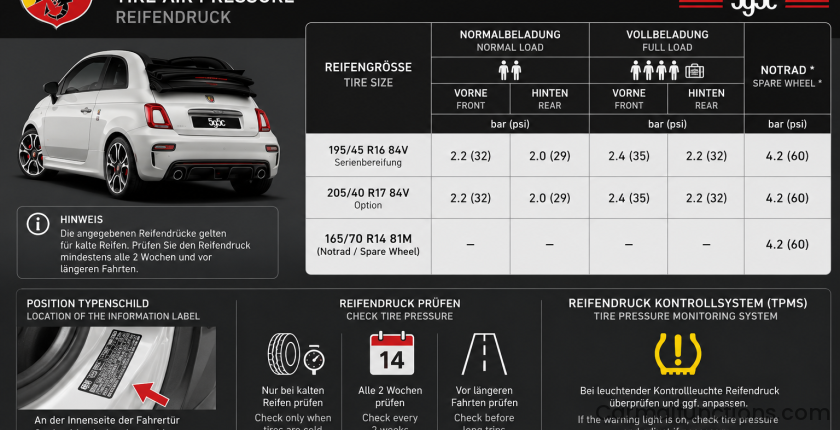
Maintaining the correct Abarth 595C tire pressure is absolutely critical. It ensures your vehicle’s peak performance, safety, and longevity. For most Abarth 595C models under normal load conditions, the recommended tire pressure is set at 2.3 bar (33 PSI) for the front tires and 2.1 bar (30 PSI) for the rear tires.
These specific values directly influence your car’s road holding, braking distances, and fuel efficiency. Checking your tire pressure regularly enhances driving safety and significantly extends the life of your tires. You can easily find the exact specifications for your specific model on the vehicle’s door pillar sticker or inside the owner’s manual.
Why Is Correct Tire Pressure Crucial for Your Abarth 595C?
Maintaining optimal tire pressure provides numerous benefits. It does not just improve ride quality; it also significantly impacts your safety. Proper inflation optimizes the tire’s contact patch with the road, which is a critical factor for every single journey.
1. Safety and Road Holding
Optimal tire pressure noticeably improves your vehicle’s handling. It shortens braking distances and maintains crucial stability during emergency maneuvers.
Conversely, under-inflation reduces the tire’s grip on the road surface. This can become incredibly dangerous, especially around sharp corners or on wet roads.
Over-inflation carries similar risks. It causes excessive wear right down the center of the tire, which negatively impacts overall traction.
2. Performance and Driving Dynamics
The Abarth 595C is specifically engineered to deliver a sporty, dynamic driving experience. Correct tire pressure maximizes this potential.
Tires act as a fundamental component of your vehicle’s suspension system. Proper inflation ensures the suspension works effectively. Ultimately, this delivers crisper steering responses and far greater driving pleasure. During performance-oriented driving, fine-tuning your tire pressure becomes even more critical.
3. Tire Lifespan and Fuel Efficiency
Incorrect tire pressure rapidly shortens the lifespan of your tires by causing irregular wear patterns.
-
Under-inflation: Causes excessive wear on the tire shoulders (outer edges).
-
Over-inflation: Causes the center section of the tread to wear out much faster.
Both scenarios force you to change your tires prematurely. Furthermore, low tire pressure increases fuel consumption. This happens because the tires suffer from higher rolling resistance, meaning the engine has to work much harder. Correct pressure optimizes fuel economy, saving you money at the pump.
4. Ride Comfort
Properly inflated tires cushion your ride. They help absorb minor impacts and imperfections from the road surface.
Aversely, over-inflated tires stiffen the ride, causing you to feel every single bump aggressively. Under-inflated tires reduce stability and can cause a floating, swaying sensation. Optimal pressure strikes the perfect balance between comfort and performance.
Recommended Tire Pressure Values for Abarth 595C
Tire pressure values for Abarth 595C models can vary based on the vehicle’s load and the specific tire size installed. Always verify these figures with the sticker on your car’s door pillar or the owner’s manual. However, the official guidelines below provide an excellent baseline.
Normal Load Conditions
These values are highly recommended for daily driving with light loads. They provide the best balance for the majority of driving scenarios.
| Tire Position | Pressure in Bar | Pressure in PSI |
| Front Tires | 2.3 bar | 33 PSI |
| Rear Tires | 2.1 bar | 30 PSI |
System Note: These baseline figures are fully compatible with the default pre-set pressures programmed into Abarth’s TPMS (Tire Pressure Monitoring System).
Full Load Conditions
When your vehicle is fully loaded with multiple passengers and heavy luggage, you must increase your tire pressure. This extra air supports the additional weight and keeps your drive safe.
| Tire Position | Pressure in Bar | Pressure in PSI |
| Front Tires | 2.5 – 2.6 bar | 36 – 38 PSI |
| Rear Tires | 2.3 – 2.4 bar | 33 – 35 PSI |
Tire Size Variations
The Abarth 595C comes equipped with various factory tire sizes. The most common dimensions are 195/45 R16 and 205/40 R17. Small baseline differences may apply depending on your exact setup. For instance, some 17-inch performance variants specify 2.2–2.3 bar (32–33 PSI) for the front and 2.1–2.2 bar (30–32 PSI) for the rear. Always check your vehicle’s specific door placard to confirm.
When and How Should You Check Tire Pressure?
Consistently maintaining correct pressure requires a regular routine. This simple check takes just a few minutes but saves a lot of hassle.
[Check Monthly / Before Trips] ➔ [Ensure Tires Are Cold] ➔ [Measure with Gauge] ➔ [Adjust to Target PSI]
-
Control Frequency: Check your tire pressure at least once a month. You should also check it before embarking on long road trips. Seasonal temperature shifts make these checks even more vital, especially when winter cold drops your pressures.
-
The Meaning of “Cold” Tires: Always measure pressure when the tires are cold. This means the car has been parked for at least three hours, or has driven less than 1.5 km (1 mile). Sürüş sırasında lastikler ısınır (Tires warm up during driving). Heated air expands, which temporarily raises the pressure reading and provides misleading data.
Step-by-Step Measurement Guide
-
Get a Reliable Gauge: Use a high-quality digital or analog tire pressure gauge.
-
Remove the Valve Cap: Unscrew the cap from the tire valve stem.
-
Press Firmly: Press the gauge firmly onto the valve stem. Ensure no air escapes while taking the reading.
-
Compare the Figures: Match the reading against your vehicle’s recommended specs.
-
Adjust the Air: If the pressure is low, add air with a compressor. If it is too high, press the center valve pin down to bleed some air out.
-
Replace the Cap: Screw the valve cap back on tightly to protect against dirt and moisture.
The Serious Risks of Incorrect Tire Pressure
Operating your Abarth 595C with incorrect tire pressures can cause dangerous issues. These problems affect everything from safety to performance.
Dangerous Effects of Under-Inflation
-
Accelerated Wear: The tire shoulders carry the load, leading to rapid, uneven wear.
-
Extreme Heat Build-up: Low pressure makes the tire sidewalls flex excessively. This creates friction and extreme heat, which can cause a sudden, catastrophic tire blowout.
-
Wasted Fuel: Increased rolling resistance forces the engine to burn more fuel.
-
Compromised Handling: Steering response becomes sluggish, and your emergency braking distances increase significantly.
-
Hydroplaning Risk: The tire cannot evacuate water efficiently on wet roads, greatly increasing the risk of sliding out of control.
Dangerous Effects of Over-Inflation
-
Center Tread Wear: The middle of the tire bulges out and takes all the friction, wearing down prematurely.
-
Harsh, Stiff Ride: The tire loses its ability to flex. This means it fails to absorb bumps, ruining your cabin comfort.
-
Reduced Grip: The tire’s actual contact patch with the road shrinks. This drastically reduces traction around corners or on slippery surfaces.
-
Impact Damage: Over-inflated tires are incredibly rigid. This makes them highly susceptible to potholes, which easily causes internal tire bruising or cracked rims.
Understanding Your Tire Pressure Monitoring System (TPMS)
Modern Abarth 595C models come equipped with a factory TPMS. This safety feature serves as an excellent backup, but it does not replace manual care.
-
How It Works: The system utilizes internal wheel sensors to constantly track your air pressure. If the pressure drops below a pre-set safety threshold, a warning light illuminates on your dashboard instrument cluster.
-
What to Do If the Light Turns On: Pull over safely as soon as possible. Manually measure all four tires with a physical gauge and inflate them to the recommended cold specs. Once corrected, the warning light usually resets and turns off automatically after driving a short distance.
-
Why TPMS Alone Is Not Enough: The TPMS is a reactive warning system, not a precise maintenance gauge. It generally triggers only after your tire pressure has already dropped dangerously low. To keep your tires at the optimal performance level, you must use a manual gauge. Additionally, keep in mind that internal TPMS sensor batteries usually last around 4 to 6 years before requiring replacement.
Key Factors That Naturally Alter Tire Pressure
Tire pressure constantly fluctuates due to environmental and driving variables. Understanding these factors helps you keep them perfectly dialed in.
Temperature Swings
Ambient outdoor temperatures affect your tires directly. As a general rule, every 5.5°C (10°F) drop in temperature reduces your tire pressure by roughly 0.07 bar (1 PSI). Conversely, hot summer weather increases pressure. You must check your tires more frequently during sudden seasonal transitions.
Altitude and Driving Style
Changing altitude alters the external atmospheric pressure, slightly shifting the relative pressure inside the tire. Furthermore, aggressive cornering or high-speed highway driving generates internal tire heat, which temporarily spikes your air pressure readings.
Comprehensive Abarth 595C Tire Care Tips
To maximize the performance, safety, and lifespan of your high-performance hatch, implement these essential maintenance habits:
-
Regular Rotations: Rotate your tires every 8,000 to 10,000 kilometers. This ensures even tread wear across the front and rear axles, saving you money in the long run.
-
Wheel Alignment & Balancing: If your car pulls to one side or your steering wheel vibrates, get a professional rot-balans (alignment and balancing) check. Misalignment shreds tire tread rapidly.
-
Monitor Tread Depth: Check your tread depth regularly. The legal minimum is typically 1.6 mm, but replacing them earlier preserves vital wet-weather grip.
-
Choose the Right Tires: A sporty car like the Abarth 595C deserves premium rubber. Select high-quality summer, winter, or all-season tires that fully match your local climate and meet the factory load and speed indexes.
Frequently Asked Questions (FAQs)
What is the ideal tire pressure for an Abarth 595C?
Under normal load conditions, the ideal pressure is 2.3 bar (33 PSI) for the front tires and 2.1 bar (30 PSI) for the rear tires. If the car is fully loaded with passengers and cargo, increase these to 2.5–2.6 bar (36–38 PSI) front and 2.3–2.4 bar (33–35 PSI) rear.
How often should I check my Abarth’s tire pressure?
You should check it at least once a month and always right before heading out on a long road trip.
Why do the front and rear tires require different pressures?
The front and rear axles require different pressures because of the car’s weight distribution and front-wheel-drive dynamics. The front end houses the engine and transmission, demanding higher pressure to handle the extra weight.
How does temperature affect my tire pressure?
Every 5.5°C (10°F) drop in temperature decreases your tire pressure by about 1 PSI. Rising temperatures cause the pressure to increase. This is why you must always measure your tires when they are completely cold.
What should I do if my TPMS dashboard light turns on?
Find a safe spot to pull over and check your pressures manually with a tire gauge. Inflate the low tires to their proper specifications. The light will turn off automatically after you drive a short distance.