Tire Air Pressure for 1995 Alfa Romeo Spider
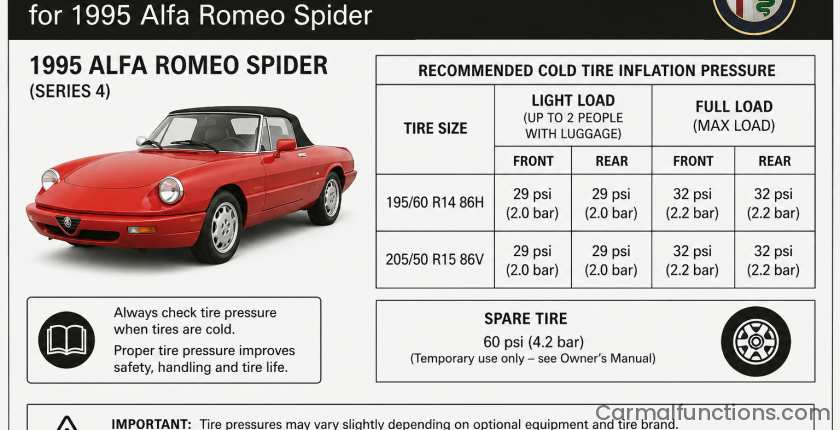
Maintaining the correct tire pressure for your 1995 Alfa Romeo Spider is critical for your vehicle’s performance, safety, and tire longevity. Generally, the recommended tire pressure for 1995 Alfa Romeo Spider models varies depending on tire size and load conditions. For most standard tire sizes, front tires require between 2.2...

- 1. Why Is Ideal Tire Pressure Important for a 1995 Alfa Romeo Spider?
- 2. Recommended Tire Pressure Values for 1995 Alfa Romeo Spider
- 3.
- 4. How to Check and Adjust Tire Pressure
- 4.1. Required Equipment
- 4.2. Step-by-Step Inspection and Adjustment Process
- 5. Benefits of Correct Tire Pressure
- 5.1. Enhanced Safety
- 5.2. Prolonged Tire Lifespan
- 5.3. Optimized Performance
- 6. Factors Affecting Tire Pressure in a 1995 Alfa Romeo Spider
- 6.1. Temperature Fluctuations
- 6.2. Load Conditions
- 6.3. Tire Age and Structural Integrity
- 6.4. Altitude
- 7. Frequently Asked Questions (FAQ)
Maintaining the correct tire pressure for your 1995 Alfa Romeo Spider is critical for your vehicle’s performance, safety, and tire longevity. Generally, the recommended tire pressure for 1995 Alfa Romeo Spider models varies depending on tire size and load conditions. For most standard tire sizes, front tires require between 2.2 and 2.7 bar (approx. 32-39 PSI), while rear tires need between 2.2 and 2.5 bar (approx. 32-36 PSI). Correct pressure directly impacts your driving experience; ensuring your tires are at their ideal pressure provides optimal road holding, braking performance, and fuel efficiency. Below you will find detailed tables and Frequently Asked Questions.
Why Is Ideal Tire Pressure Important for a 1995 Alfa Romeo Spider?
Correct tire pressure is of paramount importance for any vehicle, but this is especially true for a classic sports car like the 1995 Alfa Romeo Spider. Ideal pressure improves your vehicle’s grip on the road, shortens braking distances, and increases stability during cornering—maximizing safety for both driver and passengers.
Incorrect tire pressure can lead to numerous problems:
-
Under-inflation: Causes tires to overheat, significantly increasing the risk of a blowout. It also causes uneven wear on the tire shoulders and increases fuel consumption.
-
Over-inflation: Reduces the tire’s contact patch with the road, leading to poor handling and rapid wear along the center of the tread.
Both conditions shorten tire lifespan, decrease fuel economy, and can potentially damage your vehicle’s suspension system.
Recommended Tire Pressure Values for 1995 Alfa Romeo Spider
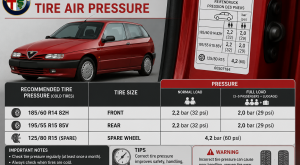
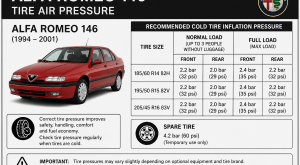
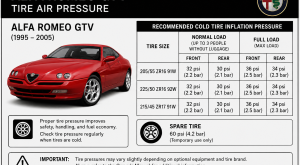
The recommended tire pressure for the 1995 Alfa Romeo Spider varies based on the tire size used and the vehicle’s load condition. You can usually find this information on the sticker located on the inside of the driver’s door pillar or in the owner’s manual.
Note: The pressure rating stamped on the tire sidewall indicates the maximum permissible pressure, not the recommended everyday operating pressure.
The table below provides general recommendations for different tire sizes and load conditions. These values are for reference purposes; always verify with your vehicle’s specific placard.
| Tire Size | Load Condition | Front Tire Pressure (PSI) | Front Tire Pressure (Bar) | Rear Tire Pressure (PSI) | Rear Tire Pressure (Bar) |
| 195/60R15 | Normal Load | 33-37 | 2.3-2.6 | 30 | 2.1 |
| 205/50R16 87V | Normal Load | 32 | 2.2 | 32 | 2.2 |
| 205/50R16 87V | Full Load | 36 | 2.5 | 36 | 2.5 |
| General Rec. (Alfa Workshop) | Normal Load | 39 | 2.7 | 36 | 2.5 |
Some sources suggest 33 PSI front and 30 PSI rear for 195/60R15 tires on 1995–2005 Alfa Romeo Spider models. Another source specifies 37 PSI (2.6 bar) for 195/60R15 W 88 tires. Meanwhile, the Alfa Workshop recommends 2.7 bar (approx. 39 PSI) for the front and 2.5 bar (approx. 36 PSI) for the rear. These variations may depend on the tire manufacturer, region, or specific vehicle sub-models, making your car’s door placard the ultimate authority.
How to Check and Adjust Tire Pressure
Checking your tire pressure regularly is an easy process that is vital for your safety. You should check it monthly and before embarking on long road trips.
Required Equipment
-
A reliable tire pressure gauge (digital or dial-type/manual).
-
An air compressor (available at gas stations or for home use).
Step-by-Step Inspection and Adjustment Process
-
Ensure Tires Are Cold: Always measure tire pressure when the tires are cold. The vehicle should be parked for at least three hours or driven less than 1.5 km (1 mile).
-
Remove the Valve Cap: Carefully unscrew the valve cap from each tire and place them somewhere safe so they don’t get lost.
-
Attach the Pressure Gauge: Press the tire pressure gauge firmly onto the valve stem. A brief hissing sound is normal. The gauge will display the current pressure.
-
Read the Pressure: Digital gauges display the reading on a screen, while manual gauges use a pop-up bar or a dial indicator.
-
Compare with Recommendations: Compare your reading against the recommended tire pressure listed on your vehicle’s door placard or owner’s manual.
-
Adjust Accordingly:
-
If pressure is low: Use an air compressor to slowly add air to the tire. Recheck the pressure periodically until you reach the desired level.
-
If pressure is high: Depress the small pin in the center of the valve stem using the nipple on your pressure gauge or a small tool to bleed off air. Recheck and repeat until correct.
-
-
Reinstall Valve Caps: Once all adjustments are complete, screw the valve caps back on tightly to protect the valve stems from dirt and moisture.
Benefits of Correct Tire Pressure
Maintaining optimal tire pressure delivers several distinct advantages that elevate your 1995 Alfa Romeo Spider’s overall performance and driving dynamics.
Enhanced Safety
-
Superior Road Holding: Properly inflated tires maintain maximum contact with the road surface, improving handling.
-
Shorter Braking Distances: Optimal pressure optimizes braking performance, providing shorter stopping distances in emergencies.
-
Increased Stability: It keeps your vehicle more stable through corners and at highway speeds, giving the driver greater control.
-
Reduced Blowout Risk: Tires that are neither under-inflated nor over-inflated face significantly lower risks of sudden, catastrophic structural failure.
Prolonged Tire Lifespan
-
Even Wear: Correct pressure ensures the tire tread wears down evenly across its width, maximizing longevity.
-
Reduced Heat Build-up: Adequate inflation prevents excessive heat generation inside the tire structure, which can otherwise degrade the rubber compound.
Optimized Performance
-
Better Fuel Efficiency: Properly inflated tires exhibit lower rolling resistance, meaning the engine works less and fuel economy improves.
-
Crisp Steering Response: Ideal pressure keeps the steering feel sharp, precise, and responsive, boosting overall driving pleasure.
-
More Comfortable Ride: Tires absorb road imperfections much better when properly pressurized. Over-inflated tires result in a harsh, bumpy ride.
Factors Affecting Tire Pressure in a 1995 Alfa Romeo Spider
Tire pressure fluctuates over time due to various environmental and operational variables, making routine inspections indispensable.
Temperature Fluctuations
Ambient temperature directly impacts tire pressure. When the temperature drops, tire pressure falls; conversely, as temperatures rise, pressure increases. As a general rule of thumb, tire pressure changes by approximately 1 PSI for every 10°C change in temperature. Consequently, checking your tires during seasonal transitions or abrupt weather shifts is crucial.
Load Conditions
The weight your vehicle carries affects its tire pressure requirements. When transporting more passengers or luggage than usual, you may need to increase the inflation level. Your vehicle’s door placard outlines values for fully loaded conditions; for a fully laden 1995 Alfa Romeo Spider, boosting both front and rear pressures up to 2.5 bar (approx. 36 PSI) might be necessary.
Tire Age and Structural Integrity
Tires naturally lose air over time through microscopic permeation or minor valve stem leaks. Older tires may lose pressure at an accelerated rate. Regularly inspect your tires for wear, cracks, or embedded objects, and consult a professional if you spot irregular wear patterns.
Altitude
When traveling to higher elevations, atmospheric pressure decreases, causing the air inside the tire to expand slightly. While this increases measured tire pressure, the effect is generally less pronounced than changes driven by ambient temperature.
Frequently Asked Questions (FAQ)
How often should I check my 1995 Alfa Romeo Spider’s tire pressure?
You should check your tire pressure at least once a month and before every long road trip to ensure your tires stay in ideal condition.
Should I inflate my tires to the pressure listed on the tire sidewall?
No. The value printed on the tire sidewall is the maximum weight-bearing pressure capacity of the tire itself. Always use the vehicle-specific pressure recommended on your driver’s door placard or in the owner’s manual.
What does “cold tire pressure” mean?
Cold tire pressure refers to readings taken after the vehicle has been parked for at least three hours or driven less than 1.5 km. Tires heat up during operation, which naturally expands the air inside and elevates the pressure reading artificially.
What happens if my tires are under-inflated?
Under-inflated tires degrade road holding, extend braking distances, and raise fuel consumption. They also run hotter and wear out prematurely along the outer edges, spiked with a higher risk of tire blowouts.
What happens if my tires are over-inflated?
Over-inflated tires reduce the rubber contact patch with the road, impairing handling and braking. They create a harsh ride quality, accelerate wear along the center of the tread, and make the tire highly susceptible to impact damage or punctures.
What type of gauge should I use to check tire pressure?
Both digital and manual (dial or pencil-style) pressure gauges work well, provided they are calibrated and reliable. Built-in gas station compressor gauges can frequently be inaccurate, so keeping a personal gauge in your glove box is highly recommended.
Should I check the pressure of the spare tire as well?
Yes, always verify that your spare tire is inflated to its correct pressure so it is ready for immediate deployment in an emergency. Spare tires often require a higher storage pressure than standard road tires.