Alfa Romeo GTV Tire Air Pressure
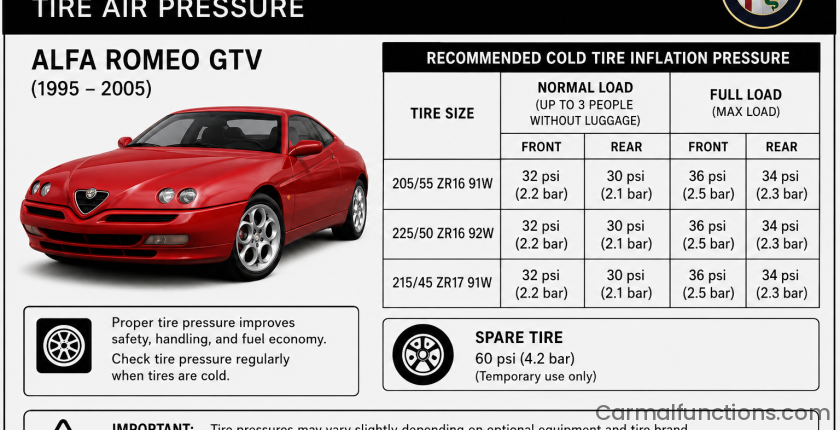
Maintaining the correct tire pressure for your Alfa Romeo GTV is critical for your vehicle’s safety and driving performance. Keeping your tires at the proper PSI values provides better handling, increases fuel efficiency, and extends tire life. According to the latest data, recommended tire pressures for the Alfa Romeo GTV...

- 1. Why Is Tire Pressure Important for the Alfa Romeo GTV?
- 1.1. Impact on Safety
- 1.2. Performance and Fuel Efficiency
- 1.3. Tire Lifespan and Wear
- 2.
- 3. Recommended Tire Pressure Values for the Alfa Romeo GTV
- 3.1. General Guidelines and Model Variations
- 4. How to Correctly Check and Adjust Tire Pressure
- 4.1. Required Tools
- 4.2. Step-by-Step Inspection Guide
- 5. Factors Affecting Tire Pressure
- 5.1. Temperature Shifts
- 5.2. Load and Driving Conditions
- 5.3. Natural Diffusion and Micro-Leaks
- 6. Tire Pressure Monitoring Systems (TPMS)
- 6.1. How TPMS Works
- 6.2. Limitations of TPMS
- 7. Pro-Tips for Tire Care and Longevity
Maintaining the correct tire pressure for your Alfa Romeo GTV is critical for your vehicle’s safety and driving performance. Keeping your tires at the proper PSI values provides better handling, increases fuel efficiency, and extends tire life. According to the latest data, recommended tire pressures for the Alfa Romeo GTV vary based on tire size and load conditions. For instance, on 1994–2005 GTV models under normal load, front tires should be set to 2.3 bar (33 psi) and rear tires to 2.1 bar (30 psi). Under full load, these values increase to 2.5 bar (36 psi) for the front and 2.3 bar (33 psi) for the rear. Checking the sticker on your vehicle’s door pillar or the owner’s manual will provide the most accurate information. Routinely checking tire pressure is vital, as incorrect levels can lead to dangerous driving conditions, increased fuel consumption, and premature tire wear. Below you will find detailed tables and Frequently Asked Questions.
Why Is Tire Pressure Important for the Alfa Romeo GTV?
Correct tire pressure directly influences many of your vehicle’s core characteristics, with driving safety being paramount. Because your tires are the only contact point between the vehicle and the road, improper pressure disrupts this contact, reduces grip, and extends braking distances. This balance is especially vital for a performance-oriented car like the Alfa Romeo GTV. Maintaining optimal tire pressure ensures sharper steering response in corners, increases steering precision, and delivers a balanced overall driving experience.
Impact on Safety
Improper tire pressure carries serious safety risks. Under-inflated tires generate excessive heat, which can trigger sudden tire blowouts. Conversely, over-inflated tires reduce the overall contact patch, potentially causing a loss of control during sudden braking or sharp turns. Your vehicle’s stability systems operate at their best only when tires are correctly pressurized. Regular checks keep both you and your passengers protected.
Performance and Fuel Efficiency
Optimal tire pressure directly impacts your fuel economy. Under-inflated tires suffer from increased rolling resistance, forcing the engine to work harder and consume more fuel. Correct pressure ensures an ideal contact patch with the road surface, minimizing friction and optimizing fuel efficiency. To keep your Alfa Romeo GTV’s acceleration and braking capabilities at their peak, close attention to tire pressure is required.
Tire Lifespan and Wear
Tires represent a significant financial investment, and correct inflation extends their operational life. Under-inflation causes rapid wear along the tire shoulders, while over-inflation wears out the center of the tread prematurely. Both scenarios cut tire lifespan short, and irregular wear patterns degrade overall performance. Setting your tires to the correct pressure ensures even wear, maximizing their longevity.
Recommended Tire Pressure Values for the Alfa Romeo GTV
Tire pressure for the Alfa Romeo GTV can vary depending on the model year, tire size, and vehicle load. The most reliable figures can always be found in your owner’s manual or on the placard located on the driver’s door pillar or inside the fuel filler flap. These labels generally display recommended values in both PSI (Pounds per Square Inch) and bar.
General Guidelines and Model Variations
The following combinations serve as a reference guide for various Alfa Romeo GTV models and tire configurations:
| Model / Tire Size | Load Condition | Front Tire Pressure (PSI / bar) | Rear Tire Pressure (PSI / bar) |
|
GTV (1994–2005)
205/55 R16 or 215/45 R17 |
Normal Load | 33 psi (2.3 bar) | 30 psi (2.1 bar) |
|
GTV (1994–2005)
205/55 R16 or 215/45 R17 |
Full Load | 36 psi (2.5 bar) | 33 psi (2.3 bar) |
| Alfa Romeo GTV (General) | Unspecified | 39 psi (2.7 bar) | 36 psi (2.5 bar) |
|
GTV (1995–2006)
195/60R15 |
Unspecified | 33 psi (2.3 bar) | 30 psi (2.1 bar) |
|
GTV (1995–2006)
225/45R17 |
Unspecified | 38 psi (2.6 bar) | 36 psi (2.5 bar) |
|
GTV (1995–2006)
205/50R16 |
Unspecified | 38 psi (2.6 bar) | 36 psi (2.5 bar) |
|
Sports Cars
(Low Profile Tires) |
General Guidelines | ~40 psi (~2.8 bar) | ~40 psi (~2.8 bar) |
Crucial Rule: These values are a general guide. Always prioritize the specific data on your vehicle’s factory labels. Tire pressure must be measured when tires are “cold”—meaning the vehicle has been parked for at least three hours or driven less than a mile.
How to Correctly Check and Adjust Tire Pressure
Checking your Alfa Romeo GTV’s tire pressure is a quick, straightforward process that should be incorporated into your routine maintenance.
Required Tools
-
Tire Pressure Gauge: Digital or mechanical dial gauges work best. Rely on a trusted personal gauge, as public service station gauges can often be inaccurate due to heavy wear.
-
Air Compressor: A portable 12V compressor or a gas station air station will allow you to top off or adjust inflation levels.
Step-by-Step Inspection Guide
-
Ensure Tires Are Cold: For absolute accuracy, always measure before driving heavily. Ensure the car has been stationary for at least three hours.
-
Identify the Target PSI: Check your driver’s door pillar sticker or owner’s manual to find the precise values, noting that front and rear requirements may differ.
-
Remove the Valve Cap: Unscrew the protective cap from the tire valve stem by turning it counter-clockwise.
-
Take the Measurement: Firmly press your pressure gauge onto the valve stem. Ensure a tight seal so that no air escapes (a brief hiss is normal, but constant leaking means it isn’t seated correctly). Read the measurement.
-
Compare the Figures: Match your measured reading against the vehicle’s recommended setting.
-
Adjust the Air Volume: If the pressure is low, connect a compressor to add air. If it is too high, use the small nipple on the back of your gauge (or a small tool) to press the center pin of the valve stem and release air. Re-check the pressure.
-
Secure the Valve Cap: Replace the valve cap securely by turning it clockwise. These caps keep out dirt, moisture, and road debris. Repeat for all remaining tires.
Factors Affecting Tire Pressure
Tire pressure is dynamic and shifts based on environmental elements and driving habits. Recognizing these factors helps you manage your tire maintenance more effectively.
Temperature Shifts
Ambient air temperature has a prompt, physical effect on tire pressure. Cold weather causes the air inside to contract, dropping the pressure, while hot weather causes it to expand. As a baseline rule, tire pressure changes by roughly 1 PSI for every 10 degrees (Fahrenheit/Celsius scale appropriate) of ambient temperature shift. This makes seasonal transitions a key time for frequent manual checks.
Load and Driving Conditions
The weight your car carries reshapes your tire footprint. If you intend to drive your Alfa Romeo GTV fully loaded with passengers or luggage, or if you are preparing for sustained high-speed highway travel, increasing your tire pressure to the factory “Full Load” specifications is required to prevent sidewall overheating and ensure high-speed safety.
Natural Diffusion and Micro-Leaks
Tires naturally lose air over time via a process called microscopic permeation through the rubber compounds. A loss of roughly 1 to 2 PSI per month is entirely normal. However, sudden or faster drops usually point to underlying issues like embedded nails, bead leaks, or a faulty valve core. Regular checkups reveal these issues before they turn into road failures.
Tire Pressure Monitoring Systems (TPMS)
Many modern vehicles feature a built-in Tire Pressure Monitoring System (TPMS) designed to monitor inflation levels in real time and warn drivers of low pressure.
How TPMS Works
TPMS utilizes electronic sensor modules mounted inside each wheel assembly. These sensors relay live pressure data directly to the vehicle’s central computer. If the internal pressure drops beneath a pre-programmed threshold, a dedicated warning light illuminates on the dashboard. This is a massive step forward for active safety.
Limitations of TPMS
While a TPMS dashboard light is a phenomenal emergency safety net, it is not a replacement for manual tire maintenance. Most factory TPMS systems are calibrated to trigger an alert only after pressure has fallen by 20% to 25%. However, even a minor 5% drop can negatively affect your fuel economy, tire wear, and sharp handling. For a performance car like the GTV, manual gauge checks remain essential.
Pro-Tips for Tire Care and Longevity
Comprehensive tire care involves checking more than just pressure; regular habits ensure safety and get the absolute most value out of your tires.
-
Monthly Routine Inspection: Check pressure at least once a month and prior to long road trips.
-
Detailed Visual Audits: Regularly scan the inner and outer sidewalls for cuts, bulging, cracks, or punctures from road debris.
-
Monitor Tread Depth: Check your remaining tread regularly using a depth gauge to ensure it stays safely above legal limits and maintains wet-weather channeling capabilities.
-
Tire Rotation and Balancing: Rotating your tires regularly helps distribute wear evenly across all four positions. While front-to-rear rotation intervals generally land between every 6,000 to 8,000 miles, always defer to your GTV model manual guidelines. Wheel balancing cuts down on chassis vibrations and saves suspension components from premature wear.
-
Selecting the Right Match: Ensure replacement tires mirror the exact load indices, speed ratings, and structural dimensions specified by Alfa Romeo. Additionally, choosing dedicated seasonal compounds (summer performance or winter specialized) keeps your vehicle performing flawlessly year-round.
peak handling characteristics.