C003A Right Front ABS Sensor Intermittent Error
Comprehensive Guide to Code C003A: Right Front ABS Sensor Intermittent Fault Encountering the C003A Right Front ABS Sensor Intermittent Fault can be highly concerning. This specific diagnostic trouble code (DTC) indicates that the Anti-Lock Braking System (ABS) control module has detected a periodic or inconsistent signal loss from the right...

- 1. Comprehensive Guide to Code C003A: Right Front ABS Sensor Intermittent Fault
- 2. What is an Intermittent Right Front ABS Sensor Fault?
- 3. Technical Causes of Intermittent Wheel Speed Sensor Failures
- 3.1. 1. Wiring Harness and Connector Vulnerabilities
- 3.2. 2. Tone Ring (Reluctor Ring) Anomalies
- 3.3. 3. Air Gap Deviations
- 3.4. 4. Internal Sensor Degradation
- 3.5. 5. Wheel Bearing or Hub Assembly Play
- 4.
- 5. Key Symptoms of a C003A Fault Code
- 6. Modern Diagnostic Techniques
- 6.1. Advanced Scan Tool Evaluation
- 6.2. Detailed Visual Inspection
- 6.3. Multimeter Electrical Testing
- 6.4. Live Data Logging & The “Wiggle Test”
- 6.5. Oscilloscope Analysis
- 7. Repair and Resolution Options
- 7.1. Component Cleaning
- 7.2. Harness Repair
- 7.3. Sensor Replacement
- 7.4. Hub and Tone Ring Replacement
- 8. Estimated Repair Costs
- 8.1. ABS Component Financial Estimates
- 9. Safety Implications: Is it Safe to Drive with This Code?
- 10. Preventive Maintenance Strategies
- 11. Next-Generation Sensor Technology Trends
Comprehensive Guide to Code C003A: Right Front ABS Sensor Intermittent Fault
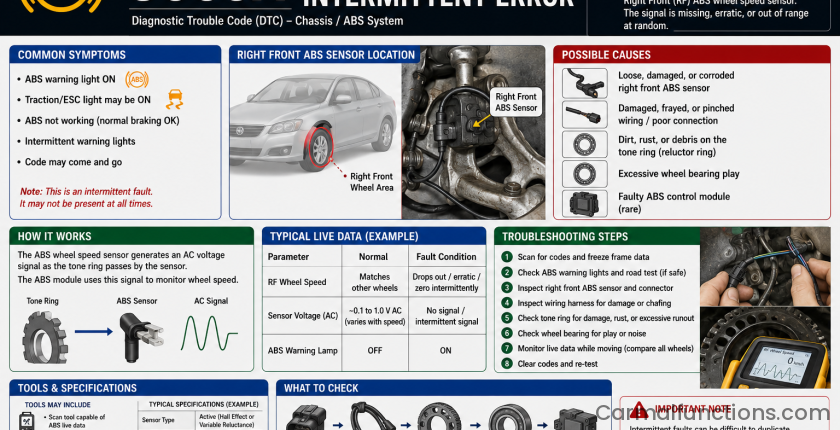
Encountering the C003A Right Front ABS Sensor Intermittent Fault can be highly concerning. This specific diagnostic trouble code (DTC) indicates that the Anti-Lock Braking System (ABS) control module has detected a periodic or inconsistent signal loss from the right front wheel speed sensor.
In modern automotive engineering, wheel speed sensors are critical safety components. They track individual wheel velocity to prevent locking during heavy braking situations. This comprehensive technical guide covers the causes, symptoms, and the latest diagnostic and repair procedures for this fault.
What is an Intermittent Right Front ABS Sensor Fault?
An Anti-Lock Braking System relies on constant data loops. Each wheel features a speed sensor that streams real-time rotational frequency back to the main ABS module. If a wheel’s speed drops drastically compared to the others—indicating an impending skid—the module adjusts hydraulic brake pressure to maintain steering control.
An intermittent fault means the sensor is not completely dead; instead, it works correctly under certain circumstances but experiences dropouts under others. These dropouts are frequently triggered by real-world driving variables, such as:
-
Chassis and road vibrations
-
Moisture intrusion and temperature cycling
-
Steering angles that stretch or bend localized wiring
Because the right front sensor is exposed directly to road debris, steering motion, and environmental elements, it is highly susceptible to this type of erratic behavior. If left unresolved, this fault will also disable secondary safety systems that rely on wheel speed data, including Traction Control (TCS) and Electronic Stability Control (ESC).
Technical Causes of Intermittent Wheel Speed Sensor Failures
Pinpointing an intermittent electrical fault requires understanding the delicate physical and magnetic relationships at the wheel hub.
1. Wiring Harness and Connector Vulnerabilities
-
Insulation Chafing: The right front sensor wiring must flex whenever the vehicle turns or hits a bump. Over time, this constant motion, combined with engine bay heat and road spray, can crack the wire insulation, causing intermittent short-circuits to the vehicle chassis.
-
Terminal Pin Corrosion: Weather seals on electrical connectors can degrade. If moisture enters the plug, it oxidizes the metal pins, introducing high electrical resistance that alters or chokes out the sensor’s signal back to the computer.
-
Internal Wire Shearing: Stranded copper wires can break inside intact plastic insulation near tight harness bends, creating a connection that physically opens and closes as the suspension moves.
2. Tone Ring (Reluctor Ring) Anomalies
The sensor tracks wheel speed by reading a rotating, toothed metallic component called a tone or reluctor ring.
-
Debris Contamination: Road grime, thick rust scale, or magnetic metallic shavings from brake wear can pack into the valleys between the teeth, smoothing out the ring’s profile and confusing the sensor.
-
Physical Damage: Cracked, missing, or warped teeth on the ring alter the magnetic pulses, registering as a wheel speed drop at a specific point in the hub’s rotation.
3. Air Gap Deviations
The precise space between the tip of the ABS sensor and the face of the tone ring is known as the air gap. This clearance typically ranges from 0.2 mm to 1.5 mm.
-
If the air gap becomes too wide, the magnetic field weakens significantly, causing the module to lose the signal at low speeds or over rough terrain. This can be caused by rust building up under the sensor mount, or an improperly seated sensor body.
4. Internal Sensor Degradation
The internal circuitry of the sensor—whether passive or active—can break down internally from years of thermal expansion and contraction, creating micro-cracks in its housing that let moisture in.
5. Wheel Bearing or Hub Assembly Play
If the vehicle’s front wheel bearing begins to fail and develops physical play, the entire hub configuration will wobble subtly. This structural movement constantly shifts the air gap spacing while driving, generating an intermittent C003A code.
Key Symptoms of a C003A Fault Code
When the ABS module logs a C003A code, the vehicle will present several distinct behavioral warnings:
-
Illuminated Dashboard Warning Lights: The ABS light will turn on. Because it is an intermittent fault, the light may cycle on and off or light up only when driving over rough surfaces or turning tight corners.
-
Deactivation of TCS and ESC Systems: Since traction and stability management require highly accurate speed metrics to function safely, the vehicle will automatically disable these networks, turning on the stability control warning light as a precaution.
-
Unwarranted Brake Pedal Pulsation: You may feel an unexpected kicking or pulsing sensation under light braking on perfectly dry, flat pavement. This occurs because the intermittent signal dropout fools the computer into thinking the right front wheel has locked up, causing it to rapidly pulse the hydraulic valves unnecessarily.
-
Speedometer Inconsistencies: On certain modern car models where the vehicle speed calculation is averaged from the front wheel sensors rather than a transmission output shaft, an erratic sensor can cause the speedometer needle to bounce or drop unexpectedly.
Modern Diagnostic Techniques
Diagnosing a fluctuating signal requires a step-by-step strategy to avoid replacing perfectly functional components.
[OBD-II Scan] ──> [Visual Inspection] ──> [Live Data Monitoring] ──> [Oscilloscope Analysis]
Advanced Scan Tool Evaluation
Connect a high-end diagnostic scan tool capable of reading manufacturer-specific chassis codes. Standard powertrain readers will often miss ABS data. Review the Freeze Frame data paired with the C003A code; this records variables like vehicle speed, system voltage, and brake switch position at the exact moment the fault occurred.
Detailed Visual Inspection
Raise the vehicle and remove the right front wheel. Carefully inspect the sensor body, the routing of its harness, and structural mountings. Look for any evidence of harness rubbing against the axle or suspension struts. Disconnect the plug and check for green or white corrosion on the internal contact pins.
Multimeter Electrical Testing
-
Passive Sensors (Two-wire variable reluctance): Set your digital multimeter (DMM) to Ohms ($\Omega$). Measure across the sensor terminals. Healthy sensors typically register stable resistance between 800 and 2000 Ohms. An infinitely high reading indicates an open circuit, while an erratic display points to internal breakdown.
-
Active Sensors (Hall-effect / Magnetoresistive): Do not measure resistance on active sensors, as the multimeter’s internal battery testing voltage can permanently fry the internal logic. Instead, back-probe for steady reference voltage supply coming down from the ABS module.
Live Data Logging & The “Wiggle Test”
Set your scanner to live graphing mode and select all four wheel speed sensors. Have an assistant drive the vehicle slowly in a straight line. Watch for the right front wheel speed to suddenly plunge to zero or spike erratically compared to the other three linear tracks.
Diagnostic Tip: If the car is parked, you can perform a “Wiggle Test.” While monitoring live sensor data on your scanner, vigorously shake the right front wiring harness and connector by hand. If the speed metric spikes or jumps during this physical manipulation, you have found the exact spot of the wiring break.
Oscilloscope Analysis
An oscilloscope provides the most accurate view of an intermittent issue by mapping out the sensor’s raw wave patterns:
-
Passive Sensors: Should produce a clean, uniform AC sine wave that increases in frequency and amplitude as the wheel is spun faster.
-
Active Sensors: Should display a crisp, uniform digital square wave toggling cleanly between set low and high voltage thresholds. Drops, distorted wave shoulders, or missing steps in the pattern point to damaged tone ring teeth or a failing sensor.
Repair and Resolution Options
Once your diagnostics narrow down the root cause, apply the corresponding fix below:
Component Cleaning
If the sensor is structurally sound but coated in road grime or ferrous debris, remove it from the knuckle and wipe the tip clean. Use a soft brush to clear away any metallic slivers wedged inside the tone ring segments.
Harness Repair
If the wiggle test reveals an isolated break in the wiring loom, cut out the compromised section. Solder in a fresh automotive-grade wire segment and seal it with marine-grade adhesive-lined heat shrink tubing to completely block moisture entry. Avoid temporary crimp connectors in high-flex wheel wells.
Sensor Replacement
If the sensor fails electrical resistance or scope analysis, it must be replaced.
-
Clean the mounting bore thoroughly with a wire brush to remove any rust scale that could alter the new sensor’s air gap.
-
Apply a thin coating of anti-seize lubricant to the body of the new sensor.
-
Seat it completely flush into the knuckle and torque the retaining bolt precisely to factory specifications.
Hub and Tone Ring Replacement
If the tone ring is cracked or the wheel bearing has too much mechanical play, the ring or the entire hub assembly must be swapped out. On many modern vehicle designs, the tone ring and sensor are integrated directly into a sealed wheel bearing assembly, meaning a complete hub swap is required.
Estimated Repair Costs
Repair pricing varies depending on the vehicle’s make and model, labor rates, and whether the issue is a simple wiring fix or requires replacing an integrated wheel hub assembly.
ABS Component Financial Estimates
| Repair Component | Part Cost (USD) | Labor Cost (USD) | Total Average Estimated Cost (USD) |
| ABS Sensor Only | $40 – $250 | $60 – $300 | $100 – $550 |
| Wiring Harness Repair / Pigtail | $15 – $50 | $50 – $150 | $65 – $200 |
| Integrated Wheel Hub / Bearing Assembly | $120 – $450 | $100 – $350 | $220 – $800 |
Safety Implications: Is it Safe to Drive with This Code?
Driving with an intermittent C003A code carries notable safety risks:
-
Unpredictable Braking Assistance: Because the fault is intermittent, the ABS system might work fine one moment and turn off the next. This unexpected shifting between assisted and manual braking can catch a driver off guard during an emergency stop.
-
Loss of Emergency Controls: When the ABS warning light is actively glowing, the anti-lock functions are completely disabled. Under heavy braking, your wheels can lock up, causing the vehicle to skid and stripping away your ability to steer around obstacles.
-
Increased Risk in Poor Weather: Driving without ABS, Traction Control, and Stability Control on wet, snow-covered, or icy roads significantly increases the risk of spinning out or losing control.
Critical Warning: If the dashboard displays both the ABS light and the standard brake warning light (red exclamation point) at the same time, this indicates a catastrophic hydraulic system failure or critically low brake fluid. Stop driving immediately and have the vehicle towed.
Preventive Maintenance Strategies
To prevent wheel speed sensor issues from returning, incorporate these habits into your regular vehicle maintenance routine:
-
Clean the Wheel Wells During Car Washes: Use a high-pressure rinse to clear away road salt, mud, and heavy brake dust buildup around the inner wheel hubs and brake components.
-
Inspect Harnesses During Brake Jobs: Whenever you change your brake pads or rotate your tyres, inspect the ABS sensor cables for any signs of rubbing, cracking, or loose mounting clips.
-
Maintain Correct Wheel Alignment: Incorrect alignment angles can place unnecessary tension on wheel well wiring harnesses during sharp turns, accelerating internal wire wear.
Next-Generation Sensor Technology Trends
The role of the wheel speed sensor has expanded significantly beyond basic anti-lock braking functions:
-
Active Multi-Data Sensors: Modern sensors do more than track RPMs; they can also detect the direction of wheel rotation (forward or reverse) and measure subtle magnetic variations to gauge tire pressure deviations directly through the hub.
-
ADAS and Autonomous Integration: Advanced Driver Assistance Systems—such as Adaptive Cruise Control, Automatic Emergency Braking (AEB), and Lane Keep Assist—rely heavily on ultra-precise wheel speed data to fine-tune automated braking interventions safely.
-
Vehicle-to-Everything (V2X) Networking: In connected vehicle ecosystems, wheel speed dropouts across multiple cars can automatically flag hazardous, icy, or slick road conditions, instantly warning surrounding traffic through cloud networks.