Abarth Punto Evo Tire Pressure
Why Correct Abarth Punto Evo Tire Pressure is Vital Correct tire pressure forms the foundation of your driving safety. Since tires are your vehicle’s only point of contact with the road, improper pressure directly compromises this grip. Achieving optimal pressure enhances handling, shortens braking distances, and ensures better control during...

- 1. Why Correct Abarth Punto Evo Tire Pressure is Vital
- 1.1. Impact on Safety
- 1.2. Fuel Efficiency and Tire Lifespan
- 2.
- 3. Understanding Abarth Punto Evo Tire Pressure Recommendations
- 3.1. Pressure Values for Standard Loads
- 3.2. Pressure Values for Full Load and High-Speed Driving
- 4. Checking Abarth Punto Evo Tire Pressure: Step-by-Step Guide
- 4.1. Required Tools
- 4.2. Control Procedure
- 4.3. Interpreting the Readings
- 5. Adjusting Abarth Punto Evo Tire Pressure
- 5.1. Inflation Process
- 5.2. Deflation Process
- 5.3. Safety Precautions
- 6. Factors Affecting Abarth Punto Evo Tire Pressure
- 7. Optimal Abarth Punto Evo Tire Pressure Maintenance
- 7.1. Regular Checks
- 7.2. Visual Inspections and Wear Tracking
- 7.3. Professional Service and Tire Replacement
- 8. Frequently Asked Questions (FAQ)
Why Correct Abarth Punto Evo Tire Pressure is Vital
Correct tire pressure forms the foundation of your driving safety. Since tires are your vehicle’s only point of contact with the road, improper pressure directly compromises this grip. Achieving optimal pressure enhances handling, shortens braking distances, and ensures better control during cornering—significantly reducing the risk of accidents.
Furthermore, proper tire pressure directly influences fuel consumption. Under-inflated tires increase rolling resistance, forcing your engine to work harder and consume more fuel. Maintaining the correct pressure optimizes fuel efficiency and extends tire lifespan by promoting even tread wear. Incorrect inflation causes uneven wear, leading to premature tire replacement. Regularly checking your tire pressure protects both your wallet and your safety.
Impact on Safety
Tire pressure is a critical component of your vehicle’s safety systems. Incorrect pressure disrupts vehicle stability, which poses severe dangers during sudden maneuvers or adverse weather conditions by reducing grip on slippery surfaces and degrading braking performance.
-
Under-inflation: Causes the tire sidewalls to flex excessively, leading to overheating and potential tire blowouts.
-
Over-inflation: Reduces the tire’s contact patch with the road surface, decreasing traction and increasing the risk of a blowout upon sudden impacts.
Fuel Efficiency and Tire Lifespan
Under-inflated tires noticeably increase your fuel consumption; every 1 psi drop can cause a 0.2% loss in fuel efficiency. While this seems minor, it adds up significantly over time.
Correct pressure ensures even tire wear, meaning you can use your tires longer. Incorrect pressure leads to localized accelerated wear:
-
Low pressure wears down the tire’s shoulders (edges).
-
High pressure wears down the center of the tread.
Both scenarios shorten tire life. Additionally, correct pressure preserves the internal structure of the tire, maintaining its overall performance.
Understanding Abarth Punto Evo Tire Pressure Recommendations
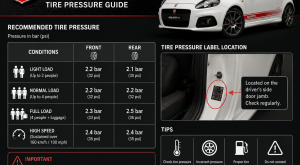
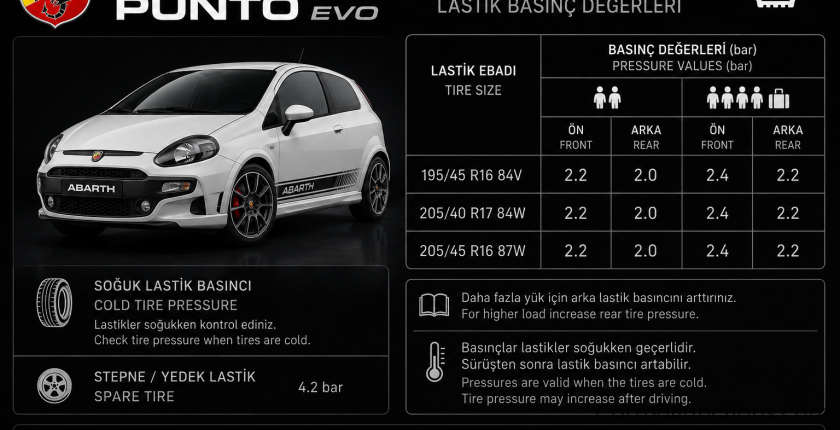
Knowing the correct tire pressure for your Abarth Punto Evo is crucial. These manufacturer-specified values can be found on the door pillar, inside the fuel filler flap, or in the owner’s manual. These labels show specific pressure values for different load conditions and tire sizes, usually specified as “cold tire pressure.” Tires should be measured when cold—meaning before driving or after the vehicle has been parked for an extended period.
Pressure Values for Standard Loads
For daily driving and light loads (a few passengers and light luggage), specific pressure values apply based on the most common tire sizes:
| Tire Size | Front Tire Pressure (bar / psi) | Rear Tire Pressure (bar / psi) |
| 205/45 R17 88V | 2.4 bar / 35 psi | 2.2 bar / 32 psi |
| 215/45 R17 91Y | 2.3 bar / 33 psi | 2.1 bar / 30 psi |
| 195/45 R16 (Abarth Punto) | 2.4 bar / 35 psi | 2.2 bar / 32 psi |
Pressure Values for Full Load and High-Speed Driving
When the vehicle is fully loaded or traveling at high speeds, you must increase the tire pressures to ensure safety and prevent the tires from overheating:
| Tire Size | Front Tire Pressure (bar / psi) | Rear Tire Pressure (bar / psi) |
| 205/45 R17 88V | 2.7 bar / 39 psi | 2.4 bar / 35 psi |
| 215/45 R17 91Y | 2.3 bar / 33 psi | 2.3 bar / 33 psi |
| 195/45 R16 (Abarth Punto) | 2.6 bar / 38 psi | 2.4 bar / 35 psi |
Note: If you are measuring warm tires, you should add 0.3 bar (approx. 4 psi) to the specified value. However, it is always best to check them when cold.
Checking Abarth Punto Evo Tire Pressure: Step-by-Step Guide
You should check your tire pressure every 15 days and always before setting off on a long journey.
Required Tools
-
A reliable tire pressure gauge (digital or analog).
-
A tire inflator/air pump (if adjustment is needed).
Control Procedure
-
Ensure Tires are Cold: For the most accurate measurement, tires must be cold. This means the car has been parked for at least a few hours or driven only a very short distance.
-
Remove the Valve Cap: Unscrew the valve cap on the tire by turning it counterclockwise.
-
Attach the Pressure Gauge: Press the gauge firmly onto the valve stem. You might hear a brief hissing sound, which is normal. The gauge will display the current pressure.
-
Read the Value: Note the reading and compare it with the recommended values on your vehicle’s door pillar or owner’s manual.
-
Check All Tires: Repeat the process for all four tires. Do not forget to check your spare tire, as it may require a different pressure value.
-
Reinstall Valve Caps: Screw the valve caps back on tightly to prevent dirt and moisture from entering the valve core.
Interpreting the Readings
Your pressure gauge will display readings in either PSI or bar. Pay attention to which unit your vehicle’s label uses. If the measured value is lower than recommended, you need to inflate the tire. If it is higher, you must release some air.
Warning: Never exceed the maximum pressure rating stamped on the tire’s sidewall. This is the maximum pressure the tire can safely withstand, not the recommended driving pressure.
Adjusting Abarth Punto Evo Tire Pressure
Inflation Process
If your tires are under-inflated, use an air pump (available at most gas stations or via a portable inflator). Attach the pump nozzle firmly to the tire valve and add air until you reach the target pressure, checking frequently with your gauge. If you overshoot the target, gently press the pin in the center of the valve to release some air. Be patient and aim for precise measurements.
Deflation Process
If your tires are over-inflated, remove the valve cap and use a small tool or the ridge on the back of your pressure gauge to press the small center pin inside the valve. Air will escape. Measure regularly as the pressure drops, and release the pin once you hit the ideal value. Reinstall the valve cap.
Safety Precautions
-
Always wear eye protection, as small particles can fly out when air escapes the valve.
-
Always adjust tires when they are cold.
-
Never exceed the maximum inflation pressure written on the tire sidewall.
-
Park your vehicle on a flat surface while checking and adjusting pressure.
-
Always put the valve caps back on to protect the valve core.
Factors Affecting Abarth Punto Evo Tire Pressure
Tire pressure is not a static value and changes due to several external factors:
-
Temperature Fluctuations: Air temperature significantly impacts tire pressure. As a rule of thumb, every 10°C (18°F) change in temperature causes a shift of roughly 1 psi. Pressure drops in cold weather and rises in warm weather. Therefore, check your pressure more frequently during seasonal transitions or sudden cold snaps.
-
Vehicle Load: Heavy luggage or extra passengers place more stress on the tires. In these cases, inflate your tires to the manufacturer’s “full load” recommendations to prevent excessive sidewall flexing and maintain proper handling.
-
Driving Style and Speed: Aggressive driving and high speeds generate heat, which increases internal tire pressure. This is particularly relevant for performance-oriented cars like the Abarth Punto Evo. Use high-speed or full-load values if you plan on sustained high-speed driving.
-
Tire Type and Size: Performance tires used on the Abarth Punto Evo may require different values than standard tires. If you notice a discrepancy between the tire sidewall data and your car’s placard, always prioritize the vehicle manufacturer’s recommendations.
Optimal Abarth Punto Evo Tire Pressure Maintenance
Regular Checks
Check your tire pressure at least once every two weeks and before long trips. If your Tire Pressure Monitoring System (TPMS) warning light comes on, inspect your tires immediately. This light typically activates when pressure drops 25% below the recommended level. Never ignore this warning.
Visual Inspections and Wear Tracking
Alongside pressure checks, visually inspect your tires for cuts, cracks, bulges, or uneven tread wear.
-
Center wear indicates over-inflation.
-
Edge/shoulder wear indicates under-inflation.
Tire rotation is recommended every 8,000 to 10,000 kilometers to balance out tread wear and extend tire life.
Professional Service and Tire Replacement
Have your tires inspected regularly by specialists who can check wheel alignment and balancing. When replacing worn or damaged tires on your Abarth Punto Evo, reputable performance brands include Michelin, Continental, Goodyear, Pirelli, Bridgestone, and Hankook. Always choose tires that match the Original Equipment (OE) specifications to preserve the car’s intended driving dynamics.
Frequently Asked Questions (FAQ)
How often should I check my tire pressure?
At least once every two weeks and prior to any long road trips.
Should I measure tire pressure when cold or warm?
Always when cold for the most accurate reading. Tires are considered cold if the car has been parked for at least a few hours.
Should I use the values on the door pillar or the ones stamped on the tire?
Always follow the vehicle manufacturer’s values found on the door pillar or in the manual. The pressure printed on the tire itself is the absolute maximum pressure the tire can handle, not the daily operating pressure.
What problems can incorrect tire pressure cause?
It reduces fuel efficiency, shortens tire lifespan, degrades road grip, lengthens braking distances, and increases the risk of a dangerous tire blowout.
My TPMS light turned on, what should I do?
Check and adjust your tire pressure as soon as possible. The light usually turns off automatically once the tires are inflated to the correct levels. If it stays on, visit a service center.
Are pressure values different for winter tires?
Generally, the same pressure values are recommended for winter tires. However, because cold winter temperatures cause pressure to drop faster, you need to check them more frequently.
What is the recommended tire pressure for the Abarth Punto Evo in PSI?
Depending on tire size and load, it generally ranges between 33–39 psi for the front tires and 30–35 psi for the rear tires. Check your vehicle’s specific door placard for the exact numbers.