Alfa Romeo 145 Tire Air Pressure
Importance of Correct Tyre Pressure for the Alfa Romeo 145 Correct tyre pressure is essential for the overall performance, safety, and efficiency of your Alfa Romeo 145. Since tyres are the only contact point between your vehicle and the road, maintaining the manufacturer’s recommended settings directly impacts several key areas:...

- 1. Importance of Correct Tyre Pressure for the Alfa Romeo 145
- 2. Recommended Tyre Pressure Values for Alfa Romeo 145
- 2.1. Factory Recommendations (Normal Load Conditions)
- 2.2. Adjustments Based on Tyre Size
- 2.3. Adjustments Based on Vehicle Load
- 3.
- 4. How to Correctly Check and Adjust Tyre Pressure
- 4.1. When to Check
- 4.2. Step-by-Step Guide
- 5. External Factors Affecting Tyre Pressure
- 6. Consequences of Incorrect Tyre Pressure
- 6.1. Underinflation (Low Pressure)
- 6.2. Overinflation (High Pressure)
- 7. Frequently Asked Questions (FAQ)
- 7.1. Can I check tyre pressure when the tyres are warm?
- 7.2. Should I use different pressures for winter tyres?
- 7.3. Why do my tyres constantly lose air?
- 7.4. What should I do if there is no tyre placard on my door?
Importance of Correct Tyre Pressure for the Alfa Romeo 145
Correct tyre pressure is essential for the overall performance, safety, and efficiency of your Alfa Romeo 145. Since tyres are the only contact point between your vehicle and the road, maintaining the manufacturer’s recommended settings directly impacts several key areas:
-
Safety and Handling: Proper inflation ensures an optimal contact patch with the road. This leads to predictable cornering, stable handling, and significantly shorter braking distances. Underinflatable tyres degrade steering response, while overinflated tyres reduce overall grip.
-
Fuel Efficiency: Incorrect tyre pressure increases rolling resistance. This forces the engine to work harder and consume more fuel. Keeping tyres at their optimal pressure ensures maximum fuel economy.
-
Tyre Lifespan and Wear: Well-inflated tyres wear evenly across the tread. Underinflation causes excessive wear on the outer shoulders, while overinflation wears out the center section. Both scenarios dramatically shorten the lifespan of your tyres.
-
Ride Comfort: Correctly pressurized tyres help absorb road imperfections efficiently, providing a smooth and comfortable ride without putting unnecessary strain on your Alfa Romeo’s suspension components.
Recommended Tyre Pressure Values for Alfa Romeo 145
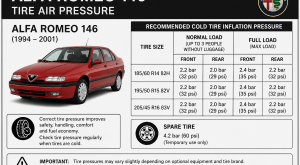
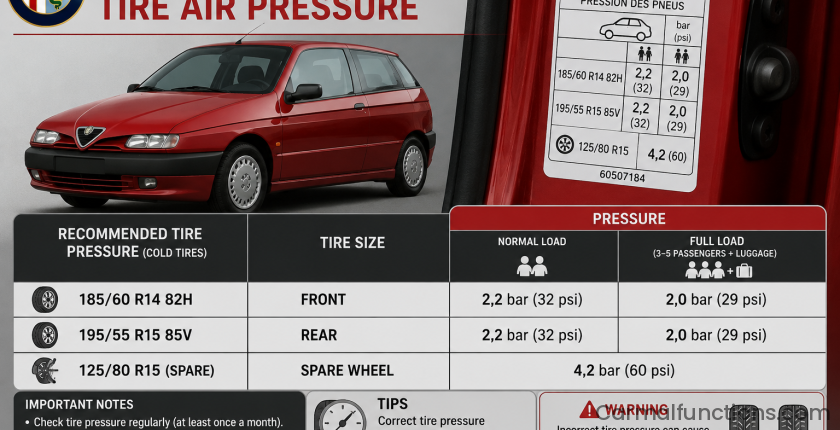
Tyre pressure requirements can vary based on the production year, engine type, and tyre size. Always prioritize the information found in your owner’s manual or on the placard located on the driver’s door pillar or inside the fuel filler flap.
Factory Recommendations (Normal Load Conditions)
| Model / Engine | Year Range | Front Tyre Pressure (PSI / Bar) | Rear Tyre Pressure (PSI / Bar) | Notes |
| Alfa Romeo 145 / 146 | 1994–1997 | 31 PSI / 2.1 Bar | 29 PSI / 2.0 Bar | For standard tyres. |
| Alfa Romeo 145 1.6 16V | 1996–2001 | 29 PSI / 2.0 Bar | 29 PSI / 2.0 Bar | Standard setup. |
| Alfa Romeo 145 1.8 / 2.0 16V | 1996–2001 | 31 PSI / 2.1 Bar | 29 PSI / 2.0 Bar | Performance variants. |
| Alfa Romeo 145 1.9 TD | 1994–2001 | 31 PSI / 2.1 Bar | 30 PSI / 2.1 Bar | Diesel variant. |
| Alfa Romeo 145 (General) | 1994–2001 | 35–41 PSI / 2.4–2.8 Bar | 32–38 PSI / 2.2–2.6 Bar | General range for high load/speeds. |
| Alfa Romeo 145 1.6 (76 kW / 103 PS) | 1994–1999 | 36–39 PSI / 2.5–2.7 Bar | 30–35 PSI / 2.1–2.4 Bar | For 175/65 R14 82H (Min-Max load). |
| Alfa Romeo 145 (2000 Model) | 2000 | 33 PSI / 2.3 Bar | 30 PSI / 2.1 Bar | For 195/55 R15 V 85 tyres. |
Adjustments Based on Tyre Size
Early Alfa Romeo 145 models typically came equipped with 175/65 R14 tyres. Later or higher-trim versions upgraded to 185/60 R15 or 195/55 R15 specifications. If you have modified your vehicle with aftermarket wheels or alternative sizes such as 185/65 R14 or 195/55 R16, consult a tyre specialist to confirm if a baseline pressure adjustment is needed.
Adjustments Based on Vehicle Load
When traveling with a full car of passengers and heavy luggage, you must compensate for the extra weight.
Load Rule: Increase your tyre pressure by up to 0.3 bar (roughly 10–15%) above the standard setting when the vehicle is fully loaded to maintain driving stability and safety.
How to Correctly Check and Adjust Tyre Pressure
When to Check
-
Check your tyre pressure at least once a month, or ideally every two weeks.
-
Always check the pressure before embarking on long road trips.
-
Crucial: Take measurements only when the tyres are cold (the vehicle should be stationary for at least two hours or driven less than 3 km).
Step-by-Step Guide
-
Get a reliable gauge: Use a high-quality digital or analog tyre pressure gauge.
-
Remove the valve cap: Unscrew the cap from the tyre valve stem.
-
Measure the pressure: Press the gauge firmly onto the valve stem. Note the reading on the display.
-
Adjust accordingly: Compare the reading with the recommended specifications. Add air using a compressor if it is low, or press the center pin of the valve to release air if it is overinflated.
-
Replace the cap: Securely screw the valve cap back on to protect the internal core from dirt and moisture.
External Factors Affecting Tyre Pressure
-
Ambient Temperature: Air density changes with weather. For every 10°C drop in temperature, tyre pressure drops by approximately 1 PSI (0.07 bar). Seasonal checks are mandatory, especially before winter.
-
Natural Air Loss: Tyre rubber is microscopically porous and naturally loses about 1–2 PSI per month. Aging valves or minor punctures can accelerate this loss.
-
Driving Style: Spirited, aggressive driving and high speeds generate friction heat, temporarily causing tyre pressure to rise while driving. This is normal, which is why cold-state measurements are standard.
Consequences of Incorrect Tyre Pressure
Underinflation (Low Pressure)
-
Overheating: The tyre sidewalls flex excessively, raising temperatures and increasing the risk of a sudden blowout.
-
Uneven Wear: Accelerated wear occurs on the outer shoulder edges, shortening tyre life.
-
High Fuel Consumption: Increased rolling resistance makes the engine work harder.
-
Compromised Handling: Sluggish steering response and an increased risk of skidding, alongside prolonged braking distances.
Overinflation (High Pressure)
-
Center Wear: The tread balloons outward, causing the middle section of the tyre to wear down rapidly.
-
Reduced Grip: The contact patch shrinks, significantly reducing traction, which is highly dangerous on wet or icy roads.
-
Harsh Ride: The tyres lose their cushioning capability, transferring every bump directly into the suspension and cabin.
-
Vulnerability: Harder tyres are more susceptible to impact damage from potholes or debris.
Frequently Asked Questions (FAQ)
Can I check tyre pressure when the tyres are warm?
No. Driving heats up the air inside the tyre, causing it to expand and give a falsely high reading. For an accurate measurement, wait until the vehicle has rested for at least 2 hours.
Should I use different pressures for winter tyres?
Cold winter temperatures cause air pressure to drop naturally. While you should generally follow your Alfa Romeo owner’s manual, some experts suggest adding 1–2 PSI to the recommended baseline during freezing winter months to offset the drop caused by the cold air.
Why do my tyres constantly lose air?
Tyres naturally permeate air over time. However, if a tyre drops pressure rapidly, check for a faulty valve core, a poorly sealed wheel rim, or a small embedded nail/screw causing a slow puncture.
What should I do if there is no tyre placard on my door?
If the driver’s door pillar label is missing, look for a specification sticker inside the fuel filler flap or check the technical data section of your Alfa Romeo 145 owner’s manual. Alternatively, an authorized Alfa Romeo workshop can look up your exact VIN configuration.