Most Fuel-Efficient Diesel Cars: Current List
The automotive landscape is constantly evolving, driven by consumer demand for efficiency, performance, and reduced environmental impact. For decades, diesel engines have held a unique position, offering superior torque and often better fuel economy than their gasoline counterparts, especially on long highway journeys. While the narrative around diesel has faced...

- 1. Understanding Modern Diesel Efficiency
- 2. The Top Contenders for Fuel Economy
- 2.1. Compact and Midsize Sedans (Where Diesel Still Shines)
- 2.1.1. Volkswagen Jetta TDI (Historical Context and Current Availability Check
- 2.1.2. The European Market Perspective
- 2.2. The SUV and Crossover Segment: Diesel Dominance
- 2.2.1. Jeep Grand Cherokee EcoDiesel
- 2.2.2. Chevrolet Colorado and GMC Canyon Duramax
- 2.3. Full-Size Trucks: Utility Meets Economy
- 2.3.1. Ford F-150 Power Stroke
- 2.3.2. Ram 1500 EcoDiesel
- 3. Factors Influencing Real-World Diesel Efficiency
- 3.1. Driving Style and Speed
- 3.2. Towing and Payload
- 3.3. Maintenance and Fuel Quality
- 3.4. Cold Weather Performance
- 4. Diesel vs. Hybrid: A Comparative Look
- 4.0.1. Highway Cruising Advantage
- 4.0.2. Fuel Range
- 5. The Future Outlook for Diesel Cars
This comprehensive guide explores the leading contenders in the current market, detailing why they excel in fuel economy and what makes them smart choices for the modern driver.
Understanding Modern Diesel Efficiency
Before diving into the specific models, it is important to understand why modern diesels offer such impressive fuel economy. Diesel engines operate on a compression-ignition cycle, which inherently allows them to extract more energy from the fuel they consume compared to spark-ignition gasoline engines. Key technological advancements have further boosted this efficiency:

- High-Pressure Common Rail Direct Injection (HPCR): Allows for precise fuel metering, leading to cleaner combustion and reduced waste.
- Advanced Turbocharging: Modern variable geometry turbochargers spool up faster and more efficiently across the rev range.
- Selective Catalytic Reduction (SCR) Systems: While primarily for emissions control (using Diesel Exhaust Fluid or DEF), these systems allow the engine to run in its most efficient combustion zones.
- 8-Speed and 10-Speed Automatic Transmissions: These transmissions keep the engine operating at its optimal RPM band for extended periods, particularly at highway speeds.
The Top Contenders for Fuel Economy
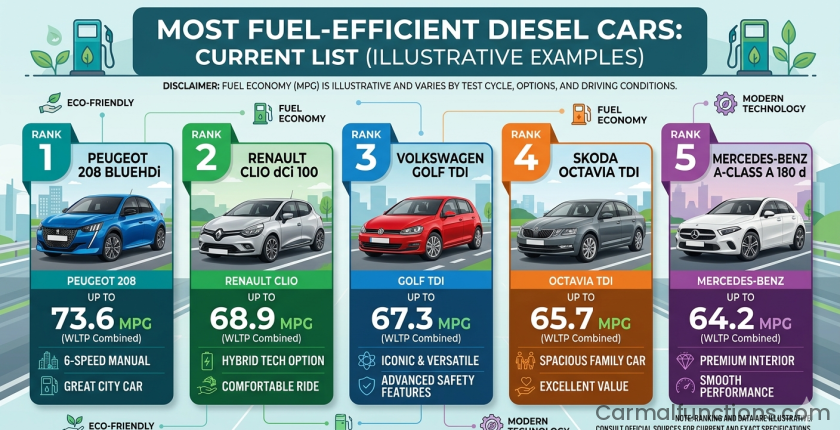
Identifying the absolute Most Fuel-Efficient Diesel Cars: Current List requires looking at EPA ratings, though real-world testing often provides the most practical data. Efficiency leaders often come from manufacturers who have heavily invested in small, advanced diesel powertrains designed primarily for efficiency rather than raw power.
Compact and Midsize Sedans (Where Diesel Still Shines)
While the sedan segment has shrunk in popularity, a few manufacturers still offer diesel options that deliver exceptional mileage figures.
Volkswagen Jetta TDI (Historical Context and Current Availability Check
Although the Jetta TDI has faced regulatory challenges in the past, its efficiency legacy is undeniable. When available in the US market, the Jetta TDI consistently delivered figures that were hard to beat for a non-hybrid vehicle. Buyers looking for the Most Fuel-Efficient Diesel Cars: Current List should check current new and used markets, as these models remain benchmarks.
The European Market Perspective
In European markets, where diesel penetration remains high, models like the Mercedes-Benz C-Class and BMW 3 Series equipped with their smallest diesel engines offer figures often exceeding 55 MPG (Imperial Gallons, translating to roughly 45-48 MPG US equivalent). These figures are achieved through lightweight construction and highly optimized 2.0-liter diesel engines.
The SUV and Crossover Segment: Diesel Dominance
SUVs are the dominant vehicle type globally, and thankfully, diesel technology has made significant inroads here, often providing the best balance of utility and fuel savings.
Jeep Grand Cherokee EcoDiesel
The Grand Cherokee equipped with the 3.0L EcoDiesel V6 is a powerhouse of efficiency relative to its size and capability. It offers robust towing capacity while achieving highway mileage that rivals some smaller gasoline crossovers. Its efficiency comes from the torque-rich nature of the V6 diesel, allowing it to cruise effortlessly.
Key Efficiency Metrics (Approximate US EPA Estimates):
| Model | Engine Size | City MPG | Highway MPG |
|---|---|---|---|
| Jeep Grand Cherokee EcoDiesel | 3.0L V6 | 22 | 32 |
| Ford F-150 Power Stroke (Light Duty) | 3.0L V6 | 20 | 27 |
| Chevrolet Colorado Duramax | 2.8L I4 | 20 | 30 |
Chevrolet Colorado and GMC Canyon Duramax
The midsize truck segment offers some of the most compelling diesel efficiency figures available today. The 2.8L Duramax four-cylinder diesel engine is specifically tuned for economy. Because it powers a lighter truck chassis than full-size counterparts, it achieves excellent highway cruising economy, making it a strong contender for the Most Fuel-Efficient Diesel Cars: Current List for truck buyers.
Full-Size Trucks: Utility Meets Economy
For those needing towing and hauling capability, the availability of modern diesel engines dramatically alters the fuel cost equation. While they won’t match compact cars, their efficiency relative to their size and capability is remarkable.
Ford F-150 Power Stroke
Ford’s 3.0L Power Stroke V6 diesel option in the F-150 redefined expectations for half-ton truck fuel economy. It often posts highway mileage figures that are competitive with older, smaller gasoline SUVs, all while retaining impressive towing capacity. This vehicle proves that efficiency doesn’t always require sacrificing utility.
Ram 1500 EcoDiesel
The Ram 1500 EcoDiesel is frequently cited as the most efficient full-size pickup truck available. Utilizing a sophisticated V6, it consistently delivers class-leading highway MPG, often pushing into the high 30s under ideal conditions. This makes it a prime candidate for drivers who commute long distances but occasionally need truck functionality.
Factors Influencing Real-World Diesel Efficiency
While official EPA ratings provide a baseline, several real-world factors can significantly influence how far you travel on a tank of diesel. Understanding these helps optimize your driving habits to stay on track with the Most Fuel-Efficient Diesel Cars: Current List.
Driving Style and Speed
Diesel engines thrive at steady, moderate speeds. Fuel economy drops sharply when speeds exceed 65 mph. Smooth acceleration and anticipation of braking maximize the benefits of the engine’s high torque band.
Towing and Payload
A diesel’s primary advantage is its ability to handle heavy loads efficiently. However, when towing near the vehicle’s maximum capacity, fuel economy will naturally decrease substantially, sometimes by 30% or more.
Maintenance and Fuel Quality
Modern diesel emissions systems (DPF filters, SCR systems) require proper maintenance. Clogged filters or neglected DEF refills can force the engine into a less efficient “limp mode.” Furthermore, the quality of Ultra-Low Sulfur Diesel (ULSD) available at the pump impacts combustion efficiency.
Cold Weather Performance
Diesel fuel gels in extremely cold temperatures, requiring additives or specialized winter blends. Additionally, the engine takes longer to reach its optimal operating temperature, leading to lower MPG in the first several miles of a trip during winter months.
Diesel vs. Hybrid: A Comparative Look
When compiling the Most Fuel-Efficient Diesel Cars: Current List, it is essential to compare them against their primary competition: gasoline hybrids. The comparison often boils down to intended use case.
Hybrids excel in stop-and-go city traffic where regenerative braking can recapture energy. Diesels, conversely, dominate highway cruising.
Highway Cruising Advantage
A typical diesel SUV achieving 32 MPG on the highway will often maintain that figure consistently across 200 miles. A comparable hybrid might achieve 40 MPG in the city but drop to 28 MPG at sustained highway speeds. For drivers logging significant interstate miles, the diesel often wins the efficiency contest.
Fuel Range
Due to the higher energy density of diesel fuel, diesel vehicles often boast significantly longer driving ranges between fill-ups than their gasoline or hybrid counterparts, which is a practical measure of efficiency for long-distance travelers.
The Future Outlook for Diesel Cars
The market for new diesel passenger cars in North America is contracting as manufacturers pivot toward electrification. However, the demand for efficient, durable diesel engines in the truck and heavy-duty SUV segments remains very strong globally.
For those seeking the Most Fuel-Efficient Diesel Cars: Current List today, the focus shifts slightly from sedans to capable SUVs and highly optimized midsize and full-size trucks. These vehicles leverage decades of diesel refinement to offer fuel economy figures that are genuinely impressive given their size and capability.
The enduring appeal of diesel lies in its torque and its superior miles per gallon on long hauls. While the electric revolution is underway, for drivers prioritizing range, towing power, and excellent highway MPG right now, modern diesel options remain an outstanding choice, providing a powerful, economical, and reliable solution for extended journeys and heavy work.