U0073 CAN Line Communication Interruption
U0073 CAN Line Communication Interruption: Causes, Symptoms, and Diagnostics The U0073 CAN Line Communication Interruption code indicates a communication failure between your vehicle’s Electronic Control Units (ECUs). This issue can disrupt vital vehicle systems and prevent them from operating correctly. Crucially, this code specifically points to a malfunction in the...

- 1. U0073 CAN Line Communication Interruption: Causes, Symptoms, and Diagnostics
- 1.1. Understanding the CAN Bus System
- 1.1.1. CAN Bus Technical Fundamentals
- 1.1.2. Key Advantages of the CAN Protocol
- 1.2.
- 1.3. Symptoms of U0073
- 1.4. Common Causes of U0073
- 1.5. Diagnostic Procedures
- 1.6. Repair Solutions
- 1.7. Frequently Asked Questions (FAQ)
U0073 CAN Line Communication Interruption: Causes, Symptoms, and Diagnostics
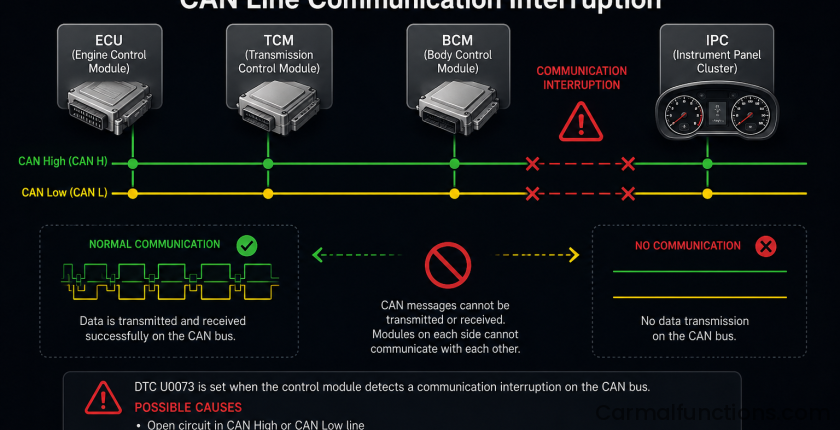
The U0073 CAN Line Communication Interruption code indicates a communication failure between your vehicle’s Electronic Control Units (ECUs). This issue can disrupt vital vehicle systems and prevent them from operating correctly. Crucially, this code specifically points to a malfunction in the primary communication line, commonly referred to as “Bus A.”
Below is a detailed breakdown of the causes, symptoms, diagnostic procedures, and current repair solutions for the U0073 code.
Understanding the CAN Bus System
Modern vehicles rely on a complex network called the Controller Area Network (CAN) bus. This network allows different modules—such as the Engine Control Module (ECM), Transmission Control Module (TCM), and Anti-lock Braking System (ABS)—to seamlessly exchange data.
A single vehicle can house over 70 ECUs. The U0073 code means this network has experienced an interruption. It signifies that the main communication line (“Bus A”) is offline or disabled—essentially acting like a “dropped call” between the vehicle’s computers.
CAN Bus Technical Fundamentals
The CAN bus minimizes complex wiring by using a twisted pair of wires (CAN High and CAN Low) operating on differential signaling. This design provides high resistance to electrical noise. Typically, CAN High is color-coded yellow, while CAN Low is green.
-
High-Speed CAN (Classical CAN): The most common variant in automotive applications, supporting data rates up to 1 Mbit/s. It requires a $120\ \Omega$ termination resistor at each end of the bus.
-
Low-Speed/Fault-Tolerant CAN: Operates up to 125 kbit/s. It is optimized for fault tolerance, allowing communication to continue even if one wire fails.
-
CAN FD (Flexible Data-Rate): An advanced variant providing faster data rates and larger payloads, essential for ADAS (Advanced Driver Assistance Systems) and modern infotainment.
-
CAN XL: Designed for ultra-fast communication in autonomous vehicles, offering even higher speeds and longer data payloads than CAN FD.
Key Advantages of the CAN Protocol
-
Efficiency: Uses non-destructive bitwise arbitration. If multiple nodes transmit simultaneously, the message with the lowest CAN ID (highest priority) wins, preventing data collisions.
-
Reliability: Features built-in error detection and handling mechanisms, alongside differential signaling to reject electromagnetic interference.
-
Cost-Effectiveness: Reduces the physical weight and production cost of the vehicle by replacing extensive dedicated wiring with a shared two-wire bus.
-
Multi-Master Capability: Eliminates reliance on a central master controller; any node can initiate communication when the bus is free.
Symptoms of U0073
The exact symptoms of a U0073 code depend heavily on which specific modules lose connection on the network.
| Symptom | Description |
| Check Engine Light (CEL) | The CEL or other warning lights (such as ABS, traction control, or stability control) will illuminate. |
| No-Start Condition | If communication with critical modules like the ECM or TCM is lost, the vehicle may refuse to crank or start. |
| Erratic Vehicle Behavior | Systems like the transmission or ABS may function unpredictably due to missing sensor data. |
| Power Loss or “Limp Mode” | The vehicle may experience a drastic reduction in power or enter a safety-induced “limp mode.” |
| Transmission Issues | You may experience delayed, harsh, or completely missed gear shifts. |
| Electronic Accessory Failures | Components like power windows, cruise control, or the radio may stop responding entirely. |
| Loss of OBD2 Scanner Communication | Diagnostic tools may suffer intermittent connectivity drops when plugged into the OBD2 port. |
| Dashboard Error Messages | Alerts such as “Service Vehicle Soon” or “Telematics Fault” may flash on the instrument cluster. |
Common Causes of U0073
An interruption on “Bus A” is generally traced back to physical wiring issues, voltage drops, or internal module failures.
| Cause | Description |
| Faulty Control Module | An internal short or failure inside a single ECU can corrupt data or pull down the entire CAN bus network. |
| Damaged Wiring or Connectors | Frayed, pinched, or broken CAN wires, as well as backed-out pins in connectors, create open circuits. |
| Corrosion / Water Intrusion | Moisture leaking into junction blocks, connectors, or modules causes corrosion, leading to high resistance. |
| Weak or Failing Battery | Low system voltage severely destabilizes network communication. Modules require stable voltage to transmit data. |
| Blown Fuse | A blown fuse powering a critical module or a gateway node will cut off its communication instantly. |
| Poor Ground Connections | Loose, rusted, or dirty chassis grounds prevent modules from maintaining stable electrical references. |
| Software or Firmware Glitches | Corrupted module software can trigger communication errors. Manufacturers frequently issue Technical Service Bulletins (TSBs) to address these via flashes. |
| Incorrect Termination Resistance | If the total resistance of the network deviates significantly from the standard $60\ \Omega$ parallel network layout, signal reflections destroy data integrity. |
| Aftermarket Equipment Interference | Improperly installed alarms, GPS trackers, or audio equipment can bleed electrical noise into the CAN lines. |
Diagnostic Procedures
Diagnosing a U0073 code requires a systematic, step-by-step approach utilizing specific automotive diagnostic tools.
-
Scan for Codes: Connect an advanced OBD-II scanner to log U0073 alongside any accompanying module-specific codes (e.g., U0100 for lost communication with ECM, U0121 for ABS). Modern diagnostic platforms utilize integrated topology mapping to visually isolate which modules are offline.
-
Verify Battery and Charging System Voltage: Ensure the battery is fully charged and testing healthy under load. Clean and torque the battery terminals; low voltage is a frequent catalyst for phantom network codes.
-
Perform a Visual Inspection: Inspect the accessible wiring harnesses and connectors linked to the primary CAN bus. Search for signs of rodent damage, rubbing against metal brackets, or water intrusion.
-
Test CAN Bus Termination Resistance: Turn off the ignition, disconnect the vehicle battery, and measure the resistance across pins 6 (CAN High) and 14 (CAN Low) at the Data Link Connector (DLC/OBD2 port) using a digital multimeter.
A healthy parallel network containing two $120\ \Omega$ resistors should read approximately $60\ \Omega$. A reading of $120\ \Omega$ indicates an open circuit in one of the lines or a missing termination resistor, while a reading near $0\ \Omega$ indicates a short circuit between the CAN High and CAN Low wires.
-
Check Ground and Power Connections: Trace and verify the integrity of the main grounds and power feeds supplying the affected modules.
-
Isolate Modulating Nodes: If a short circuit is present on the bus, systematically disconnect individual modules while monitoring the resistance or voltage levels on the CAN network. If the network stabilizes when a specific module is unplugged, that module is likely faulty.
-
Review Factory TSBs: Check for relevant Technical Service Bulletins. For instance, specific vehicle models have documented software patches or known wiring harness friction points that cause this exact error.
-
Oscilloscope Waveform Analysis: In complex cases, connect an oscilloscope to observe the physical signal layer. Normal CAN High should toggle between 2.5 V and 3.5 V, while CAN Low should toggle between 2.5 V and 1.5 V. Distorted or flat-lined wave patterns indicate specific wiring faults.
Repair Solutions
Once the root cause is isolated, the corresponding repair can be carried out:
-
Repair or Replace Wiring/Connectors: Splice damaged CAN wiring using proper automotive soldering or crimping methods, keeping the twisted configuration intact to preserve noise rejection. Replace corroded connectors.
-
Replace or Reprogram the Faulty Module: If an internal ECU failure is confirmed, replace the module. Note that most modern modules require factory-level programming and VIN flashing to function.
-
Replace Blown Fuses: Replace any blown fuses related to module power circuits and investigate what caused the overcurrent situation.
-
Battery Replacements: Replace weak batteries that drop below 12.4 V when resting or fail a standard load test.
-
Clean Ground Points: Scrape away rust or paint from loose chassis grounds, apply dielectric grease, and secure the fasteners tightly.
-
Apply Software Updates: Flash modules with the latest manufacturer software to correct internal logic bugs causing bus timeouts.
Frequently Asked Questions (FAQ)
Is it safe to drive with a U0073 code?
No, driving with an active U0073 code is highly discouraged. Because this code indicates an interruption on a critical communication line, the vehicle can experience sudden performance drops, unexpected transmission shifting, or a loss of safety systems like ABS and stability control. If the vehicle enters limp mode or stalls, it presents a serious safety risk.
Can I diagnose a U0073 code myself?
Basic checks, such as inspecting the battery condition, cleaning terminals, and checking accessible fuses or wires for damage, can be performed at home. However, advanced network diagnostics—such as measuring bus resistance, isolating modules, or analyzing waveforms—require specialized diagnostic scanners, multimeters, and an understanding of automotive electrical networks.
What is the estimated repair cost for a U0073 code?
The repair cost varies widely depending on the underlying cause. Simple wiring repairs or fuse replacements can cost between $100 and $300. However, if a major module (like the ECM or TCM) is faulty and requires replacement and programming, the total cost can easily range between $600 and $1,500+, depending on the vehicle make and model. Diagnostic labor fees typically run between $120 and $200 per hour.