Alfa Romeo 156 Tire Air Pressure
Correct tire pressure for your Alfa Romeo 156 is vital for your vehicle’s performance and safety. Maintaining recommended tire pressures directly impacts your driving safety, fuel efficiency, and the lifespan of your tires. This simple maintenance task optimizes your car’s handling and reduces the risk of unexpected situations. Below, you...

- 1. Why is Correct Alfa Romeo 156 Tire Pressure So Important?
- 2. Enhanced Safety and Handling
- 3. Optimal Fuel Efficiency
- 4. Extended Tire Life
- 5. Recommended Alfa Romeo 156 Tire Pressure Values
- 5.1. Finding Your Vehicle’s Specific Recommendations
- 5.2. General Guidelines by Engine Type and Tire Size
- 5.3. Adjusting for Load and Driving Conditions
- 6. How to Correctly Check Alfa Romeo 156 Tire Pressure
- 6.1. Proper Tools
- 6.2. Step-by-Step Measurement Guide
- 7. Frequently Asked Questions (FAQ)
Correct tire pressure for your Alfa Romeo 156 is vital for your vehicle’s performance and safety. Maintaining recommended tire pressures directly impacts your driving safety, fuel efficiency, and the lifespan of your tires. This simple maintenance task optimizes your car’s handling and reduces the risk of unexpected situations. Below, you will find detailed tables and FAQs.
Why is Correct Alfa Romeo 156 Tire Pressure So Important?
Keeping tire pressure at the right level is crucial for the overall health of your Alfa Romeo 156. This is not just a maintenance task; rather, it is a fundamental safety precaution. Correct pressure ensures ideal contact between the tires and the road surface. This contact area affects all of the vehicle’s dynamics. Specifically, it determines braking, acceleration, and cornering abilities. Incorrect tire pressure disrupts this critical balance and may cause the vehicle to react unpredictably. This can be particularly dangerous in emergency situations. Therefore, having the correct pressure is the first step in preserving your vehicle’s engineered balance.
Enhanced Safety and Handling
Correct tire pressure significantly improves your Alfa Romeo 156’s handling. Your tires are the only connection between you and the road. Consequently, properly inflated tires have an optimum contact patch, which provides maximum traction even on wet or slippery surfaces. Under-inflated tires reduce grip, delay steering response, and cause the vehicle to sway more in corners. In addition, they also extend braking distances. Over-inflated tires, on the other hand, narrow the contact patch, which lowers traction and increases the risk of loss of control during sudden braking or sharp turns. Maintaining correct pressure is essential to preserve the sporty driving characteristics of your Alfa Romeo 156.

Optimal Fuel Efficiency
Correct tire pressure directly affects fuel consumption. Under-inflated tires have higher rolling resistance. As a result, the engine must work harder to move the vehicle, which increases fuel consumption. This harms both your wallet and the environment. Over-inflated tires can also negatively impact fuel efficiency by causing excessive wear in the center of the tire. Thus, regular tire pressure checks help your vehicle reach its specified fuel efficiency values. This simple habit leads to significant savings over the long term.
Extended Tire Life
Tires are one of the most important and costly parts of your vehicle. Correct tire pressure extends the life of your tires significantly. Under-inflated tires show irregular wear on the shoulder areas, which shortens their lifespan. Conversely, over-inflated tires wear out from the center. Both situations lead to premature tire replacement. Actually, consistent and correct pressure ensures that the tire tread wears evenly. This helps your tires reach the lifespan determined by the manufacturer and reduces your replacement costs.
Recommended Alfa Romeo 156 Tire Pressure Values
The recommended values for the Alfa Romeo 156 vary based on the model, engine type, tire size, and load status. These values are carefully determined by the manufacturer to ensure optimum performance.
Finding Your Vehicle’s Specific Recommendations
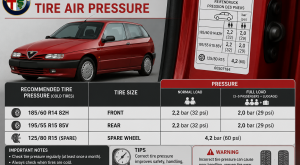
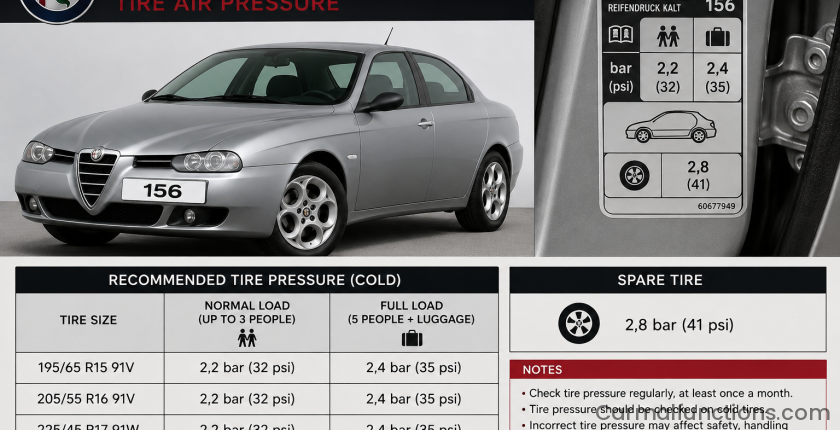
Finding the most accurate tire pressure values is easy. You should check your vehicle’s owner’s manual. Additionally, there is a sticker on the inner frame of the driver’s door or inside the fuel filler cap. These labels show the front and rear tire pressures for different load conditions (normal and full load). They are usually specified in Bar or PSI. You should always trust these official sources over general information found online.
General Guidelines by Engine Type and Tire Size
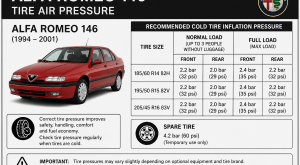
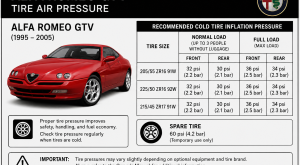
While you should always check your own vehicle’s label, the following table provides reference values for common configurations:
| Engine Type | Tire Size | Normal Load (Front) | Normal Load (Rear) | Full Load (Front) | Full Load (Rear) |
| 1.6 / 1.8 / 2.0 TS | 195/60 R15 | 2.1 Bar / 30 PSI | 1.9 Bar / 28 PSI | 2.4 Bar / 35 PSI | 2.4 Bar / 35 PSI |
| 1.6 / 1.8 / 2.0 TS | 205/55 R16 | 2.2 Bar / 32 PSI | 2.2 Bar / 32 PSI | 2.5 Bar / 36 PSI | 2.5 Bar / 36 PSI |
| 2.5 V6 / 2.4 JTD | 205/55 R16 | 2.2 Bar / 32 PSI | 2.2 Bar / 32 PSI | 2.5 Bar / 36 PSI | 2.5 Bar / 36 PSI |
| 3.2 V6 GTA | 225/45 R17 | 2.2 Bar / 32 PSI | 2.2 Bar / 32 PSI | 2.5 Bar / 36 PSI | 2.5 Bar / 36 PSI |
Adjusting for Load and Driving Conditions
Tire pressure must be adjusted according to the amount of load your vehicle is carrying. For instance, when traveling under a high load, it is necessary to increase the tire pressure to prevent excessive flexing. This reduces the risk of overheating and potential blowouts. Furthermore, tire pressure is affected by temperature changes; pressure drops in cold weather and rises in hot weather. Therefore, you should perform regular checks considering seasonal changes to ensure your tires always have the appropriate pressure.
How to Correctly Check Alfa Romeo 156 Tire Pressure
Checking tire pressure is a simple process, but knowing the right methods is important for accuracy.
Proper Tools
You need a reliable tire pressure gauge. Digital gauges usually provide more precise results, while analog gauges are always ready as they don’t require batteries. Moreover, having your own portable air compressor provides great convenience, though most gas stations have them available.
Step-by-Step Measurement Guide
-
Check your tires when they are “cold” (parked for several hours or driven a very short distance).
-
Remove the valve caps and keep them in a safe place.
-
Press the pressure gauge firmly onto the valve stem.
-
Note the pressure reading and compare it with the recommended values.
-
If the pressure is low, inflate the tire; if it is high, release air by pushing the small pin in the valve stem.
-
Repeat until the desired pressure is reached and replace the valve caps.
-
Don’t forget to check your spare tire as well.
Frequently Asked Questions (FAQ)
How often should I check my Alfa Romeo 156 tire pressure?
You should check it at least once a month and definitely before long journeys. Also, it is beneficial to check more frequently during seasonal transitions.
Which unit should I use (PSI or Bar)?
Use the unit specified on your vehicle’s label or manual. Ensure your measurement device is set to the correct unit.
Does tire pressure change with temperature?
Yes, it does. Pressure drops as the air cools and rises as it warms. Consequently, adjusting the pressure during seasonal changes is important.
Does incorrect tire pressure affect the handling of my Alfa Romeo 156?
Yes, significantly. Under-inflation reduces steering response and increases the risk of loss of control in corners, while over-inflation reduces traction by narrowing the contact area. Both negatively impact stability and safety.