P0220 Gas Pedal Position Sensor Circuit
P0220: Throttle Pedal Position Sensor Switch ‘B’ Circuit Malfunction The P0220 Diagnostic Trouble Code (DTC) indicates an electrical malfunction within the Accelerator Pedal Position Sensor (APPS) or Throttle Position Sensor (TPS) ‘B’ circuit. This issue directly impacts engine performance and vehicle drivability. When this code triggers, the Powertrain Control Module...

- 1. P0220: Throttle Pedal Position Sensor Switch ‘B’ Circuit Malfunction
- 1.1. What is the P0220 Code?
- 1.2. APPS vs. TPS: What is the Difference?
- 1.3. Symptoms of DTC P0220
- 1.4. Common Causes
- 1.5.
- 1.6. Diagnostic Steps
- 1.6.1. 1. Check for Additional DTCs
- 1.6.2. 2. Perform a Visual Inspection
- 1.6.3. 3. Inspect Wiring and Harnesses
- 1.6.4. 4. Monitor Live Data
- 1.6.5. 5. Test with a Multimeter
- 1.6.6. P0220 Diagnostic Checklist
- 1.7. How to Fix and Repair P0220
- 1.8. Severity and Drivability
- 1.9. Maintenance and Prevention
- 1.10. Frequently Asked Questions (FAQs)
- 1.10.1. Can I drive with a P0220 code?
- 1.10.2. Does a P0220 code mean my ECM/PCM is broken?
- 1.10.3. How much does it cost to fix a P0220 code?
- 1.10.4. Will this code cause an inspection failure?
P0220: Throttle Pedal Position Sensor Switch ‘B’ Circuit Malfunction
The P0220 Diagnostic Trouble Code (DTC) indicates an electrical malfunction within the Accelerator Pedal Position Sensor (APPS) or Throttle Position Sensor (TPS) ‘B’ circuit. This issue directly impacts engine performance and vehicle drivability.
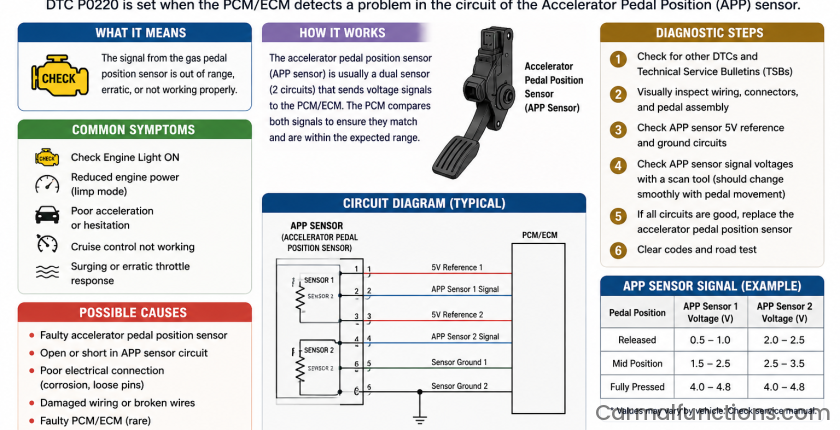
When this code triggers, the Powertrain Control Module (PCM)—the vehicle’s computer—detects an abnormal voltage signal from the sensor that tracks how far the gas pedal is pressed. In modern drive-by-wire systems, multiple redundant sensors are used for safety. If the readings from the ‘B’ sensor do not correlate with the expected parameters, the PCM flags the error. This system is vital for smooth acceleration and proper engine idling.
What is the P0220 Code?
DTC P0220 stands for “Throttle/Pedal Position Sensor/Switch ‘B’ Circuit Malfunction.” It means the PCM has detected a voltage output from circuit ‘B’ that falls outside the normal operating range.
This is a generic powertrain code applicable to all OBD-II equipped vehicles (1996 and newer). However, specific troubleshooting and repair steps may vary depending on the vehicle manufacturer.
APPS vs. TPS: What is the Difference?
While the Accelerator Pedal Position Sensor (APPS) and the Throttle Position Sensor (TPS) work toward the same goal, they are located in different areas of the vehicle:
-
Accelerator Pedal Position Sensor (APPS): Mounted directly onto the gas pedal assembly. It monitors the driver’s foot input and converts mechanical pedal movement into electrical signals. This is common in “drive-by-wire” systems where no physical cable connects the pedal to the engine. The APPS usually consists of two or three variable resistors (potentiometers).
-
Throttle Position Sensor (TPS): Mounted on the throttle body of the engine. It monitors the actual angle of the throttle valve (butterfly valve), which regulates how much air enters the engine. Modern TPS units are often contactless, utilizing Hall-effect or inductive technology.
How they work together: The PCM constantly compares the signals from the APPS and the TPS to ensure the throttle valve opens exactly as much as the driver intends. A mismatch between these sensors often triggers the P0220 code.
Symptoms of DTC P0220
When the P0220 code is stored, you may experience several noticeable drivability issues:
-
Check Engine Light (CEL) Illumination: Usually the first indicator on the dashboard.
-
Reduced Engine Power (‘Limp Mode’): The PCM restricts engine power to prevent unsafe acceleration. The vehicle may be limited to speeds of 30–50 mph.
-
Hesitation or Stumbling During Acceleration: The vehicle may jerk or lag when you press the gas pedal due to inconsistent signaling.
-
Rough Idle or Stalling: The engine might idle unevenly or shut off entirely when coming to a stop.
-
No-Start Condition: In some vehicle models, a severe sensor mismatch might prevent the engine from starting.
-
Engine Misfires: Can occur during idling or at highway speeds.
-
Poor Fuel Economy: Inefficient throttle control leads to suboptimal air-fuel mixtures.
Common Causes
-
Faulty Throttle/Pedal Position Sensor: Internal wear and tear can create “dead spots” in the sensor’s electrical contacts.
-
Damaged Wiring or Connectors: Corroded, loose, or frayed wires between the sensor and the PCM disrupt the signal. This is highly common near the throttle body pigtail harness due to engine heat and vibration.
-
Carbon Buildup in the Throttle Body: Heavy carbon deposits can physically restrict the throttle valve, throwing off sensor readings.
-
Sticky Throttle Return Spring: If the spring fails to snap the valve shut properly, a circuit error may register.
-
Obstructed Gas Pedal: A simple but frequent culprit—thick aftermarket floor mats getting wedged under the pedal.
-
Failed Throttle Body Assembly: Internal mechanical or electronic failure of the throttle body unit.
-
Defective PCM: A rare cause, which should only be considered after all other components are ruled out.
Diagnostic Steps
To avoid unnecessary parts replacement, follow this systematic diagnostic approach:
1. Check for Additional DTCs
Connect an OBD-II scanner and check for related codes. P0220 often appears alongside P0121, P0122, P0123 (TPS ‘A’ circuit issues), P0221, P0222, P0223 (TPS ‘B’ circuit issues), or P2135 (TPS/APPS correlation fault).
2. Perform a Visual Inspection
Check the throttle body and accelerator pedal area. Look for loose connections, broken wires, or signs of physical damage. Ensure the throttle body bore is clean of carbon deposits and verify that floor mats are not obstructing the pedal.
3. Inspect Wiring and Harnesses
Closely examine the wiring harness leading to the TPS and APPS. While monitoring your scan tool, gently wiggle the wire harnesses. A sudden spike or drop in data during the “wiggle test” reveals hidden wire breaks or loose pins.
4. Monitor Live Data
Use a scan tool to view live voltage data for both ‘A’ and ‘B’ sensors. As you slowly depress the gas pedal (with the key on, engine off), the voltage should climb smoothly without skipping or dropping out. Standard readings typically range from ~0.5V at idle to ~4.5V at Wide Open Throttle (WOT).
5. Test with a Multimeter
If live data is erratic, use a digital multimeter (DMM) to check for proper reference voltage (typically 5V), ground, and signal continuity according to the factory service manual.
P0220 Diagnostic Checklist
| Step | Action | Potential Finding |
| 1 | Scan for other DTCs | Identify overlapping issues (e.g., P0121, P2135) |
| 2 | Visual inspection | Detect broken wires, carbon buildup, or pedal obstructions |
| 3 | Harness wiggle test | Expose intermittent wiring or connector pin corrosion |
| 4 | Monitor live stream data | Detect voltage drops or “dead spots” during pedal travel |
| 5 | Multimeter component test | Verify if sensor resistance or voltage outputs meet factory specs |
| 6 | Evaluate the PCM | Rule out all other components before diagnosing a PCM failure |
How to Fix and Repair P0220
Depending on your diagnostic findings, the solution will involve one of the following:
-
Replace the Faulty Sensor: Replacing the degraded TPS or APPS assembly is the most frequent fix.
-
Clean the Throttle Body: Use a dedicated throttle body cleaner and a microfiber cloth to safely remove carbon sludge.
-
Repair Wiring/Connectors: Splice in a new pigtail connector or repair broken wires to restore clean electrical pathways.
-
Fix Pedal Obstructions: Adjust or replace loose floor mats that restrict pedal travel.
-
Replace the Throttle Body Assembly: Necessary if the internal return spring or integrated electronic motor has failed.
-
PCM Flash or Replacement: If the PCM is confirmed defective, it must be replaced and reprogrammed to your vehicle’s VIN.
Diagnostic Warning: Avoid the common mistake of buying a new sensor immediately. Cleaning a dirty throttle body or repairing a corroded wire harness is often much cheaper and fixes the root cause of the P0220 code.
Severity and Drivability
Severity Rating: Moderate to High
Driving with a P0220 code is not recommended. Because the vehicle can abruptly enter Limp Mode, you may suddenly lose the ability to accelerate safely on highways, creating a hazardous driving situation. Furthermore, a pending or active P0220 code will cause an automatic failure during an emissions or vehicle inspection test, as any illuminated Check Engine Light prevents certification.
Maintenance and Prevention
To prevent throttle circuit faults, incorporate these habits into your automotive maintenance routine:
-
Clean your throttle body once a year or every 15,000 miles to prevent carbon buildup.
-
Inspect engine bay wiring harnesses for signs of heat cracking or rodent damage.
-
Ensure aftermarket floor mats are securely anchored to prevent mechanical interference with the pedal.
Frequently Asked Questions (FAQs)
Can I drive with a P0220 code?
It is highly risky. The vehicle can drop into Limp Mode unexpectedly, drastically cutting power and making throttle response completely unpredictable. You should repair the issue before driving long distances.
Does a P0220 code mean my ECM/PCM is broken?
No. While the PCM monitors the circuit, actual PCM hardware failures are rare. The problem is almost always a worn-out sensor, a dirty throttle bore, or a damaged wire harness.
How much does it cost to fix a P0220 code?
-
TPS Replacement: $80 to $250 (parts and labor).
-
APPS Assembly: $100 to $800, depending heavily on the vehicle make and model.
-
Wiring Repair/Throttle Cleaning: $50 to $150 if done at a local shop.
Will this code cause an inspection failure?
Yes. Any active engine code that illuminates the Check Engine Light results in an automatic failure during state emissions and safety testing.