Abarth Tire Pressure
Maintaining the correct Abarth tire pressure is crucial for your vehicle’s performance, safety, and longevity. Proper inflation ensures optimal handling, braking, and fuel efficiency. It also prevents premature tire wear. You will find detailed tables and FAQs below. Understanding Abarth Tire Pressure Recommendations Optimal Abarth tire pressure varies by model...

Maintaining the correct Abarth tire pressure is crucial for your vehicle’s performance, safety, and longevity. Proper inflation ensures optimal handling, braking, and fuel efficiency. It also prevents premature tire wear. You will find detailed tables and FAQs below.
- 1. Understanding Abarth Tire Pressure Recommendations
- 1.1. General Guidelines for Abarth Models
- 1.1.1. Abarth 500 Tire Pressure (2026 Models)
- 1.1.2. Abarth 595 Tire Pressure (2026 Models)
- 1.1.3. Abarth 695 Tire Pressure (2026 Models)
- 2. The Importance of Correct Abarth Tire Pressure
- 2.1. Enhanced Safety and Handling
- 2.2. Improved Fuel Efficiency
- 2.3. Extended Tire Lifespan
- 2.4. Reduced Risk of Tire Failure
- 3. Checking Your Abarth Tire Pressure
- 3.1. When to Check Tire Pressure
- 3.2. How to Check Tire Pressure
- 4. Tire Pressure Monitoring System (TPMS) in Abarth Vehicles
- 4.1. How TPMS Works
- 4.2. TPMS Warning Light: What to Do
- 5. Factors Affecting Abarth Tire Pressure
- 5.1. Temperature Fluctuations
- 5.2. Driving Conditions and Load
- 5.3. Tire Type and Size
- 6. Advanced Tips for Abarth Tire Pressure Management
- 6.1. Cold vs. Hot Tire Pressure
- 6.2. Track Day Tire Pressures
- 6.3. Using a High-Quality Gauge
- 6.4. Nitrogen Inflation
- 6.5. Tire Rotation and Alignment
- 7. Common Questions about Abarth Tire Pressure
- 7.1. What is the recommended Abarth tire pressure for daily driving?
- 7.2. How often should I check my Abarth tire pressure?
- 7.3. Can I use the maximum PSI listed on the tire sidewall?
- 7.4. What happens if my Abarth tires are underinflated?
- 7.5. What happens if my Abarth tires are overinflated?
- 7.6. Does the TPMS automatically reset after adjusting tire pressure?
- 8. Conclusion
Understanding Abarth Tire Pressure Recommendations
Optimal Abarth tire pressure varies by model and tire size. Always consult your specific vehicle’s owner’s manual or the tire placard. This placard is usually located on the driver’s side door jamb, fuel filler flap, or inside the glove compartment. These sources provide the most accurate figures for your Abarth.
General Guidelines for Abarth Models
While specific values differ, general recommendations exist. Most Abarth models require different pressures for front and rear tires. This also varies between unladen and fully loaded conditions. Checking your tires when they are cold is essential for an accurate reading.
Abarth 500 Tire Pressure (2026 Models)
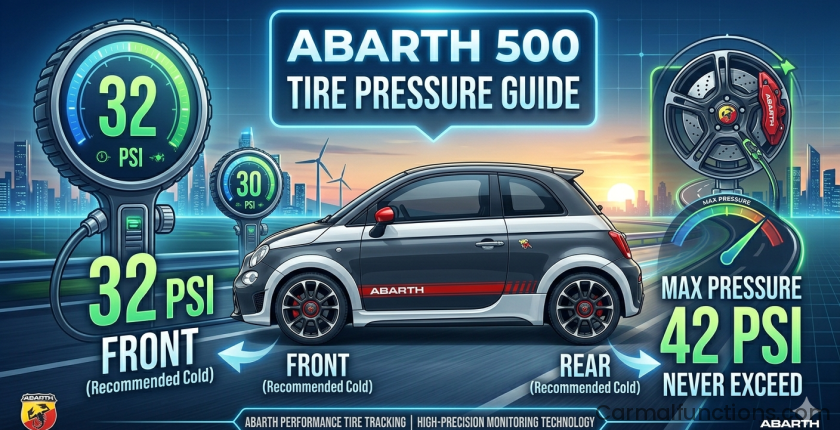
For the Abarth 500, recommended pressures depend on tire size and load. For 16-inch tires (195/45 R16), unladen front tires should be 33 psi (2.3 bar). Rear tires should be 38 psi (2.6 bar). When fully loaded, front pressure adjusts to 30 psi (2.0 bar). Rear pressure becomes 35 psi (2.4 bar). For 17-inch tires (205/40 R17), the unladen recommendations are also 33 psi (2.3 bar) for the front. Rear tires remain at 38 psi (2.6 bar). Loaded conditions for 17-inch tires also match the 16-inch figures: 30 psi (2.0 bar) front and 35 psi (2.4 bar) rear.
Here is a table summarizing typical Abarth tire pressure for the 500 model:
| Tire Size | Load Condition | Front Pressure (psi / bar) | Rear Pressure (psi / bar) |
|---|---|---|---|
| 195/45 R16 | Unladen | 33 psi / 2.3 bar | 38 psi / 2.6 bar |
| 195/45 R16 | Loaded | 30 psi / 2.0 bar | 35 psi / 2.4 bar |
| 205/40 R17 | Unladen | 33 psi / 2.3 bar | 38 psi / 2.6 bar |
| 205/40 R17 | Loaded | 30 psi / 2.0 bar | 35 psi / 2.4 bar |
These figures are general. Always check your car’s specific placard.
Abarth 595 Tire Pressure (2026 Models)
The Abarth 595 often shares tire pressure specifications with the Abarth 500. For example, a 205/40/17 84 Y tire might recommend 32-33 psi (2.2-2.3 bar) for the front. The rear pressure could be 31-32 psi (2.1-2.2 bar) for both unladen and loaded conditions. Another common recommendation for the 595 is 38 psi for the front and 32 psi for the rear. This applies to unladen conditions. Again, refer to your specific vehicle’s information.
Here is a table showing typical Abarth tire pressure for the 595 model:
| Tire Size | Load Condition | Front Pressure (psi / bar) | Rear Pressure (psi / bar) |
|---|---|---|---|
| 205/40/17 84 Y | Unladen/Loaded | 32-33 psi / 2.2-2.3 bar | 31-32 psi / 2.1-2.2 bar |
| General (unladen) | Unladen | 38 psi / 2.6 bar | 32 psi / 2.2 bar |
These figures are approximate. Your car’s door jamb sticker is the best source.
Abarth 695 Tire Pressure (2026 Models)
For the Abarth 695, recommended tire pressures also vary. For some models, normal driving conditions suggest 2.3 bar (approximately 33 psi) for the front. The rear pressure is 2.1 bar (approximately 30 psi). When fully loaded, these pressures increase to 2.5 bar (approximately 36 psi) for the front. The rear becomes 2.3 bar (approximately 33 psi). Always check your specific Abarth 695 owner’s manual or door placard.
Here is a table outlining typical Abarth tire pressure for the 695 model:
| Load Condition | Front Pressure (bar / psi) | Rear Pressure (bar / psi) |
|---|---|---|
| Normal Driving | 2.3 bar / 33 psi | 2.1 bar / 30 psi |
| Fully Loaded | 2.5 bar / 36 psi | 2.3 bar / 33 psi |
These values are for guidance. Always verify with your vehicle’s specific documentation.
The Importance of Correct Abarth Tire Pressure
Maintaining proper Abarth tire pressure offers numerous benefits. It impacts safety, driving dynamics, fuel economy, and tire lifespan. Neglecting tire pressure can lead to serious issues.
Enhanced Safety and Handling
Correct tire pressure improves vehicle maneuverability. It enhances stability on the road. It also reduces braking distances. Properly inflated tires maintain optimal contact with the road. This provides better grip and responsiveness. Underinflated tires can feel sluggish. They reduce steering precision. Overinflated tires can decrease traction. They make the ride harsher.
Improved Fuel Efficiency
Tires with the right pressure create less rolling resistance. This means your engine works less to move the car. Less effort translates to better fuel economy. Underinflated tires increase rolling resistance significantly. This wastes fuel. It costs you more money at the pump.
Extended Tire Lifespan
Properly inflated tires wear evenly across the tread. This maximizes their lifespan. Underinflation causes excessive wear on the outer edges of the tire. Overinflation leads to wear in the center of the tread. Uneven wear shortens tire life. It forces earlier replacement. This costs more money in the long run.
Reduced Risk of Tire Failure
Underinflated tires generate excessive heat. This can lead to tire damage or even blowouts. Overinflated tires are more susceptible to damage from road hazards. They also offer less flexibility. Maintaining correct pressure minimizes these risks. It keeps you safer on the road.
Checking Your Abarth Tire Pressure
Regularly checking your Abarth tire pressure is a simple task. It requires only a few minutes. This routine check is vital for optimal vehicle health.
When to Check Tire Pressure
You should check your tire pressure at least once every two weeks. Also check it before any long journey. Always measure tire pressure when the tires are cold. This means the car has not been driven for at least three hours. Alternatively, it has been driven for less than one mile. Driving heats up the tires. This increases internal pressure. A hot reading will be inaccurate.
How to Check Tire Pressure
- Gather Equipment: You need a reliable tire pressure gauge. Digital gauges offer greater accuracy.
- Locate Valve Stems: Remove the valve caps from each tire.
- Take Reading: Press the gauge firmly onto the valve stem. A brief hiss of air is normal. The gauge will display the pressure.
- Compare to Recommendations: Check the reading against your Abarth’s recommended pressure. This is found on the door jamb sticker or in the owner’s manual.
- Adjust Pressure:
- If too low: Add air using an air compressor. Recheck the pressure.
- If too high: Release air by pressing the small pin inside the valve stem. Recheck the pressure.
- Replace Caps: Reinstall all valve caps securely. This prevents dirt and moisture from entering.
Tire Pressure Monitoring System (TPMS) in Abarth Vehicles
Modern Abarth vehicles come equipped with a Tire Pressure Monitoring System (TPMS). This system warns you of significant pressure drops. It provides an important safety feature.
How TPMS Works
TPMS uses sensors inside each tire. These sensors transmit pressure data wirelessly. This data goes to your vehicle’s computer. If one or more tires fall below a certain pressure threshold, the system triggers a warning. A light illuminates on your instrument panel. An audible chime may also sound.
TPMS Warning Light: What to Do
If your TPMS light comes on, do not ignore it. It indicates a tire pressure issue. Follow these steps:
- Find a Safe Place: Pull over safely.
- Check All Tires: Manually check the pressure of all four tires with a gauge.
- Inflate as Needed: Adjust any underinflated tires to the recommended pressure.
- Reset TPMS (if necessary): Many Abarth models feature an auto-relearn TPMS. The light should turn off after driving for a period at speeds above 20 mph (32 km/h). Some models might require a manual reset procedure. Consult your owner’s manual for specific instructions.
- Inspect for Damage: If pressure drops again quickly, inspect the tire for punctures or damage.
The TPMS light is a warning. It is not a substitute for regular manual checks. Sensors can fail or batteries can die.
Factors Affecting Abarth Tire Pressure
Several environmental and driving factors influence Abarth tire pressure. Understanding these helps you maintain optimal levels.
Temperature Fluctuations
Ambient temperature significantly affects tire pressure. Tire pressure changes by approximately 1 psi (7 kPa) for every 12°F (7°C) change in air temperature. Cold weather causes tire pressure to drop. Hot weather increases it. Always check pressures more often during seasonal changes.
Driving Conditions and Load
Heavy loads require higher tire pressures. This supports the extra weight. It maintains safe handling. High-speed driving also demands correct inflation. Increased pressure might be necessary for sustained high-speed operation. Consult your tire dealer or Abarth service center for specific high-speed recommendations.
Tire Type and Size
Different tire types and sizes have varying pressure requirements. Performance tires often have specific recommendations. Always match the pressure to your installed tires. Your Abarth’s placard accounts for factory-fitted sizes. If you change tire sizes, reconfirm the correct pressure.
Advanced Tips for Abarth Tire Pressure Management
Beyond basic maintenance, some advanced tips can further optimize your Abarth’s tire performance.
Cold vs. Hot Tire Pressure
Always measure cold tire pressure. This is the baseline recommendation. As tires warm up from driving, their pressure naturally increases. Do not reduce this normal pressure build-up. Doing so will result in underinflation when the tires cool down.
Track Day Tire Pressures
For track use, optimal tire pressures differ from street driving. Many enthusiasts start slightly higher than unladen recommendations. Then they make adjustments based on tire temperatures and wear patterns. A common starting point might be around 36 psi front and 34 psi rear, adjusting downwards if tires get too hot. Some drivers aim for 30 psi hot on the track. Consult experienced track drivers or tire specialists for specific track day advice. Track use puts extreme demands on tires.
Using a High-Quality Gauge
Invest in a good quality tire pressure gauge. Cheap gauges can be inaccurate. Regular calibration ensures precise readings. This is critical for optimal performance.
Nitrogen Inflation
Some drivers opt for nitrogen inflation. Nitrogen is less susceptible to temperature changes than air. This can lead to more stable tire pressures. It may reduce the frequency of adjustments. However, regular checks remain essential. Nitrogen is not a substitute for proper maintenance.
Tire Rotation and Alignment
Regular tire rotation promotes even wear. It helps maintain consistent performance. Proper wheel alignment also prevents uneven tire wear. It ensures your Abarth handles as intended. These practices complement correct tire pressure maintenance.
Common Questions about Abarth Tire Pressure
What is the recommended Abarth tire pressure for daily driving?
The recommended Abarth tire pressure for daily driving varies. It depends on your specific model and tire size. Always check the tire placard on your driver’s side door jamb or in your owner’s manual. For many Abarth 500/595 models, unladen pressures are around 33 psi front and 38 psi rear for 16-inch and 17-inch wheels.
How often should I check my Abarth tire pressure?
You should check your Abarth tire pressure at least once every two weeks. Also check it before any long journeys. Always perform checks when the tires are cold for accuracy.
Can I use the maximum PSI listed on the tire sidewall?
No, the maximum PSI on the tire sidewall is not the recommended pressure. It indicates the maximum safe pressure the tire can withstand. Using this pressure for everyday driving is not advisable. It can impair handling, braking, and cause premature tire wear. Always follow your vehicle manufacturer’s recommendations.
What happens if my Abarth tires are underinflated?
Underinflated Abarth tires can lead to several problems. These include reduced fuel efficiency, premature wear on the outer edges of the tire, poor handling, increased braking distances, and excessive heat buildup. This heat can cause tire damage or blowouts.
What happens if my Abarth tires are overinflated?
Overinflated Abarth tires can cause uneven wear in the center of the tread. They can reduce traction and make the ride harsher. They are also more susceptible to damage from road hazards. Overinflation can lead to dangerous blowouts.
Does the TPMS automatically reset after adjusting tire pressure?
Many Abarth models feature an auto-relearn TPMS. The warning light should turn off after you adjust the pressure and drive the car. Drive for about 10-15 minutes at speeds above 20 mph (32 km/h). If the light persists, consult your owner’s manual for a manual reset procedure or check for sensor issues.
Conclusion
Maintaining the correct Abarth tire pressure is paramount. It ensures your vehicle delivers its intended performance and safety. Regular checks, understanding your specific model’s requirements, and heeding TPMS warnings are essential. Proper tire care extends tire life and optimizes fuel efficiency. Always consult your owner’s manual or door jamb placard for the most accurate and up-to-date pressure recommendations for your Abarth model. Your driving experience and safety depend on it.