P0421 Catalyst Heating Efficiency Low
P0421 Catalyst Heating Efficiency Low: Comprehensive Diagnostic and Repair Guide The P0421 diagnostic trouble code (DTC), logged by your vehicle’s Powertrain Control Module (PCM), indicates that the catalytic converter on Bank 1 is not operating efficiently enough to reduce exhaust emissions during its warm-up phase. This condition typically triggers the...

- 1. P0421 Catalyst Heating Efficiency Low: Comprehensive Diagnostic and Repair Guide
- 2. What Does P0421 Mean?
- 2.1. The Critical Role of the Catalytic Converter
- 2.2. The Function of Oxygen Sensors
- 3.
- 4. Symptoms of P0421
- 4.1. Symptom Summary Table
- 5. Common Causes of P0421
- 5.1. Potential Causes Matrix
- 6. Step-by-Step Diagnostic Protocol
- 6.1. 1. Perform a Full System Scan
- 6.2. 2. Inspect for Exhaust Leaks
- 6.3. 3. Analyze O2 Sensor Live Data
- 6.4. 4. Physical and Thermal Catalyst Tests
- 7. Repair Options and Cost Estimates
- 7.1. Estimated Repair Costs (2026 Projection)
- 8. Driving Safety and Risks
- 9. Frequently Asked Questions (FAQs)
- 9.1. Will a P0421 code clear on its own?
- 9.2. Can I pass an emissions inspection with a P0421 code?
- 9.3. What is the most common diagnostic mistake with this code?
- 9.4. Which vehicle makes encounter this code most frequently?
P0421 Catalyst Heating Efficiency Low: Comprehensive Diagnostic and Repair Guide
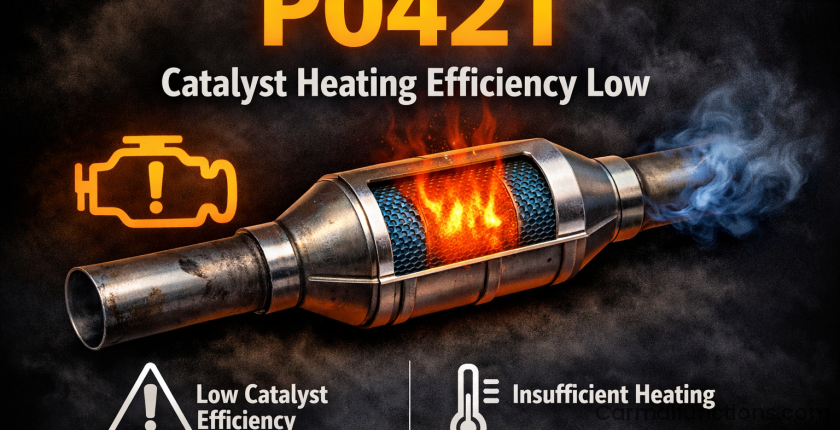
The P0421 diagnostic trouble code (DTC), logged by your vehicle’s Powertrain Control Module (PCM), indicates that the catalytic converter on Bank 1 is not operating efficiently enough to reduce exhaust emissions during its warm-up phase. This condition typically triggers the Check Engine Light and can significantly increase the volume of harmful pollutants leaving your tailpipe.
The PCM sets this code when catalytic efficiency drops below a predetermined threshold within the first 5 to 10 minutes of engine operation—a critical window known as the “warm-up” period. Below, we provide a comprehensive breakdown of this fault code, including analytical data tables and Frequently Asked Questions (FAQs).
What Does P0421 Mean?
The generic OBD-II definition for P0421 is “Warm Up Catalyst Efficiency Below Threshold (Bank 1)”. It specifies that during the initial 5 to 10 minutes of operation, the pre-catalytic converter (often called a “light-off” or “warm-up” catalyst) fails to sufficiently clean the exhaust gases.

Positioned closely to the engine exhaust manifold, this specific catalyst is designed to heat up rapidly to reduce emissions before the main catalytic converter reaches its optimal operating temperature.
To monitor efficiency, the PCM compares data from two oxygen sensors:
-
Upstream Oxygen Sensor (Sensor 1): Measures raw exhaust gases right out of the engine.
-
Downstream Oxygen Sensor (Sensor 2): Measures treated exhaust gases leaving the warm-up catalyst.
If the downstream sensor’s voltage readings begin to mirror or match the rapidly fluctuating waveform of the upstream sensor, the PCM determines that the catalyst has lost its storage capability and triggers the P0421 code.
The Critical Role of the Catalytic Converter
The catalytic converter is an indispensable component of your vehicle’s emissions control framework. It leverages precious metals—such as platinum, palladium, and rhodium—coated over a ceramic honeycomb structure to catalyze chemical reactions. This process converts highly toxic engine byproducts like carbon monoxide (CO), nitrogen oxides ($\text{NO}_x$), and unburned hydrocarbons (HC) into safer emissions: carbon dioxide ($\text{CO}_2$), nitrogen ($\text{N}_2$), and water vapor ($\text{H}_2\text{O}$).
The Function of Oxygen Sensors
Oxygen sensors (or lambda sensors) function as the feedback loop for the PCM. The upstream sensor monitors the residual oxygen content in the raw exhaust, allowing the PCM to fine-tune the real-time air-fuel ratio via fuel injection adjustments.
In a healthy system, the catalytic converter consumes oxygen to facilitate its chemical reactions, meaning the downstream sensor should output a relatively flat, stable voltage line. When the downstream sensor mimics the upstream sensor, it indicates a spent or physically damaged catalyst substrate.
Symptoms of P0421
While some drivers only notice an illuminated dashboard light, a failing catalyst or an underlying engine issue can manifest in several noticeable driving symptoms:
-
Check Engine Light (MIL) Activation: The primary and most immediate indicator.
-
Reduced Engine Performance: Noticeable power loss, sluggish acceleration, or struggling while driving uphill. This occurs if the inner core of the catalyst collapses or melts, choking the exhaust flow.
-
Increased Fuel Consumption: The engine operates outside its peak efficiency zone, consuming more fuel to maintain speed.
-
Erratic or Rough Idle: The vehicle may stumble or vibrate abnormally when stopped.
-
Sulphur or Rotten Egg Odor: A distinct chemical smell indicating that unburned fuel is overloading the catalyst, or the precious metals are failing to convert hydrogen sulfide.
-
Hard Starting Conditions: A heavily restricted or plugged exhaust stream can make starting the engine difficult.
Symptom Summary Table
| Symptom | Description | Severity Level |
| Check Engine Light | The most common indicator; requires prompt attention. | High |
| Engine Power Loss | Clear weakness during acceleration or uphill climbs. | Medium-High |
| Increased Fuel Consumption | Occurs because the engine is operating inefficiently. | Medium |
| Rough Idle | Unstable or shaky engine performance at a standstill. | Medium |
| Foul Exhaust Odor | “Rotten egg” smell; points to potential catalyst meltdown. | High |
Common Causes of P0421
While a degraded catalyst core is a primary suspect, several peripheral system failures can trick the PCM into setting this code:
-
Failing Catalytic Converter: Internal degradation, contamination, structural melting, or plugging of the precious metal core (accounts for roughly 70% of cases).
-
Defective Oxygen Sensors: A contaminated or worn-out downstream oxygen sensor providing lazy or incorrect voltage signals to the PCM.
-
Exhaust System Leaks: Cracks or unsealed joints in the exhaust manifold or flex pipe upstream of the sensors. This pulls outside air into the exhaust stream, skewing the oxygen readings.
-
Engine Misfires (e.g., P0300 – P0308): Ongoing misfires send raw, unburned fuel down the exhaust pipe. This fuel ignites inside the catalyst, causing temperatures to soar and melting the internal honeycomb structure.
-
Fuel Delivery and Air System Malfunctions: Running excessively rich (too much fuel) or lean (too much air) alters the catalyst’s operating environment, eventually causing structural fouling.
-
O2 Sensor Circuit Faults: Corroded connectors or broken wiring harnesses that disrupt signal transmission to the control unit.
-
PCM Software or Hardware Glitches: Rarely, an outdated PCM calibration may have an overly sensitive monitoring threshold that requires a software flash.
Potential Causes Matrix
| Cause | Description | Probability |
| Defective Catalytic Converter | Core degradation, contamination, or melting. | ~70% |
| Faulty Oxygen Sensor | Inaccurate voltage readings or lazy sensor response. | ~20% |
| Exhaust Leaks | Unmetered ambient air throwing off sensor readings. | ~5% |
| Engine Misfires | Unburned raw fuel overheating the catalyst core. | < 5% |
| Fuel System Imbalance | Excessively rich/lean fuel trims fouling the system. | < 5% |
| O2 Wiring Issues | Broken wires, shorted circuits, or corroded pins. | Low |
| PCM Software Flaws | Outdated calibration or internal module faults. | Very Low |
Step-by-Step Diagnostic Protocol
To prevent costly and unnecessary parts replacement, follow a structured diagnostic routine:
1. Perform a Full System Scan
Connect an OBD-II diagnostic scanner and pull all active and pending codes, along with freeze frame data. Look closely for misfire codes ($\text{P030X}$) or fuel trim codes ($\text{P0171}/\text{P0174}$). Always repair engine performance codes before replacing a catalytic converter, otherwise, you risk instantly ruining the replacement part.
2. Inspect for Exhaust Leaks
Visually inspect the exhaust manifold, gaskets, and pipes leading up to the catalyst. Look for black soot trails, rust holes, or physical cracks. You can also spray soapy water on suspect joints with the engine running cool to look for bubbling, or listen for the distinct ticking sound of an exhaust leak.
3. Analyze O2 Sensor Live Data
Monitor the real-time voltage signals of the Bank 1 sensors on your scanner. Once the vehicle reaches closed-loop operation:
-
Sensor 1 (Upstream) should actively oscillate back and forth between roughly $0.1\,\text{V}$ and $0.9\,\text{V}$.
-
Sensor 2 (Downstream) should remain stable, holding steady around $0.45\,\text{V}$ to $0.7\,\text{V}$.
Diagnostic Rule: If the downstream sensor tracks the upstream sensor’s sweeping motions, the catalytic converter is completely spent.
4. Physical and Thermal Catalyst Tests
-
Temperature Differential Test: Use an infrared laser thermometer to measure the exhaust pipe temperature directly before and directly after the catalytic converter. A properly functioning converter should show an outlet temperature that is significantly hotter than the inlet temperature due to the ongoing exothermic chemical reaction.
-
Exhaust Backpressure Test: Remove the upstream oxygen sensor and install a low-pressure gauge. If the backpressure exceeds factory specifications (typically above $1.5\,\text{to}\,2.0\,\text{PSI}$ at $2500\,\text{RPM}$), the catalytic converter is physically clogged or collapsed.
Repair Options and Cost Estimates
Once the root cause is isolated, select the appropriate repair track:
-
Exhaust Leak Remediation: Welded repairs or gasket replacements to seal unmetered air out of the system.
-
Oxygen Sensor Replacement: Installing an OEM-grade sensor if the downstream unit is lazy or dead.
-
Catalytic Converter Replacement: If the converter core is structurally degraded, it must be replaced. It is highly recommended to use original equipment or high-quality direct-fit replacements, as cheap universal catalysts frequently cause the code to return.
-
PCM Reprogramming: In some vehicle models, updating the engine software with the latest factory calibration resolves false efficiency codes.
Estimated Repair Costs (2026 Projection)
| Repair Option | Estimated DIY Cost | Estimated Professional Cost |
| Exhaust Leak Repair | 600 – 4,500 TRY | 3,000 – 15,000 TRY |
| O2 Sensor Replacement | 15,000 – 45,000 TRY | 30,000 – 90,000 TRY |
| Catalytic Converter Replacement | 120,000 – 450,000+ TRY | 240,000 – 900,000+ TRY |
| Wiring Harness Repair | 1,500 – 9,000 TRY | 4,500 – 24,000 TRY |
Note: Final repair costs fluctuate significantly based on vehicle make, engine displacement, regional labor rates, and whether you use OEM or aftermarket components.
Driving Safety and Risks
Operating your vehicle with a P0421 code does not present an immediate safety emergency. However, ignoring the issue long-term is highly discouraged.
Beyond failing environmental emissions inspections, a collapsing or melting catalytic converter can create severe exhaust restriction. This restriction drives up internal engine temperatures, chokes horsepower, and can eventually lead to irreversible internal engine damage. If you hear a loud rattling noise under the vehicle, experience a sudden drop in power, or notice a severe rotten egg odor, pull over and seek professional service immediately.
Frequently Asked Questions (FAQs)
Will a P0421 code clear on its own?
No. While the light may occasionally cycle off if operating conditions temporarily improve, the underlying mechanical or electrical fault remains. Simply erasing the code with a scanner only provides temporary relief; the PCM will turn the Check Engine Light back on once its self-test parameters fail again.
Can I pass an emissions inspection with a P0421 code?
No. An active P0421 fault code indicates that your tailpipe emissions are exceeding permissible regulatory limits. Furthermore, an illuminated Check Engine Light or unready emissions monitors will result in an automatic inspection failure in most jurisdictions.
What is the most common diagnostic mistake with this code?
The most common mistake is immediately replacing the expensive catalytic converter without checking for exhaust leaks, bad wiring, or faulty oxygen sensors first. Always verify sensor operation and rule out engine misfires before condemning the converter.
Which vehicle makes encounter this code most frequently?
While it can happen to any OBD-II compliant vehicle, P0421 is notably common on Mazda and Mitsubishi vehicles due to highly sensitive PCM monitoring software thresholds. It is also frequently found on high-mileage commuter vehicles including the Toyota Camry, Honda Civic/Accord, Ford Focus/Escape, and Subaru Outback/Forester.